
Views: 0 Author: Site Editor Publish Time: 2026-11-19 Origin: Site


GaN (Gallium Nitride) technology is a semiconductor advancement used in Class D amplifiers to switch electrical current faster and more efficiently than traditional silicon transistors. In professional sound amplifiers, GaN technology enables higher power density, lower energy consumption, and reduced heat output—allowing manufacturers to pack more wattage into smaller, lighter chassis without sacrificing audio fidelity.
Professional audio engineers, touring companies, and installation integrators are increasingly asking the same question: why does GaN technology matter for a class D power amplifier, and is it worth the investment? The short answer is that GaN semiconductors solve a long-standing engineering trade-off—power versus size versus heat—that silicon-based amplifiers have struggled to overcome for decades.
This post breaks down how GaN technology works inside a class D amplifier, why it's reshaping the professional sound amplifier market, and what to look for when comparing a high capacity PA amplifier manufacturer in China or elsewhere. We'll also look at a real-world example: the Auway DS-1300, a 1300W amplifier built on GaN architecture, to illustrate these concepts in practice.
Before diving into GaN specifically, it helps to understand the foundation it builds on. A class D power amplifier uses pulse-width modulation (PWM) to switch transistors rapidly on and off, rather than allowing current to flow continuously as in Class A or Class AB designs. This switching approach is inherently more efficient because the transistors spend most of their time either fully on or fully off, generating far less wasted heat.
Traditional class D amplifiers rely on silicon MOSFETs to perform this switching. Silicon has served the industry well for years, but it has physical limitations: switching speed, thermal conductivity, and voltage handling. As demand for higher-output, high-efficiency digital amplifier designs grew—particularly for touring rigs, stadiums, and large venues—engineers began looking for a semiconductor material that could switch faster and run cooler.
Gallium Nitride is a wide-bandgap semiconductor material. Compared to silicon, GaN transistors offer three measurable advantages relevant to amplifier design:
Faster switching speeds. GaN transistors switch on and off more quickly than silicon equivalents, which improves transient response—the amplifier's ability to accurately reproduce fast audio events like drum transients or vocal sibilance.
Higher thermal conductivity. GaN components dissipate heat more effectively, which reduces the size of heat sinks and cooling systems required inside the chassis.
Greater power density. Because GaN transistors can handle higher voltages and switch faster without excessive heat buildup, manufacturers can deliver more output wattage from a smaller circuit footprint.
These properties translate directly into real-world amplifier design choices: smaller rack units, lower power draw, and amplifiers capable of running at high output for extended periods without thermal throttling.
The table below compares key characteristics of GaN-based and silicon-based class D amplifiers, based on general engineering principles and manufacturer specifications such as those published for the Auway DS-1300.
Characteristic | GaN Technology Amplifier | Traditional Silicon Amplifier |
|---|---|---|
Switching speed | Faster, improving transient response | Slower by comparison |
Power density | Higher—more output per rack unit | Lower, requires larger chassis for equivalent power |
Power consumption | Reduced by an estimated 20–30% | Higher energy draw for similar output |
Chassis size | Compact (e.g., DS-1300 fits a 2U chassis) | Typically larger for equivalent wattage |
Heat management | Lower heat output, simpler thermal design | Requires more extensive cooling |
Typical use case | Touring, large festivals, premium installations | General-purpose sound reinforcement |
As the table shows, the core benefit of GaN isn't a single feature—it's the compounding effect of faster switching, better thermal behavior, and smaller component size working together.
Efficiency isn't just an engineering talking point; it has practical consequences for anyone running sound equipment for extended periods. A high-efficiency digital amplifier built with GaN technology draws less power from the wall while delivering the same—or greater—output as a silicon-based unit. For a festival running sound for twelve or more hours, or a stadium with a permanent installation running daily, that efficiency reduces operating costs and lowers the burden on electrical infrastructure.
Reduced power consumption also means less generated heat, which lowers the risk of thermal shutdown during peak demand—a critical factor for live events where an amplifier dropping out mid-performance isn't an option.
The Auway DS-1300 is a 1300W amplifier that illustrates how GaN technology performs in a professional sound amplifier built for demanding environments. As a 2-channel class D power amplifier, the DS-1300 delivers 2x1300W at 8Ω and 2x2350W at 4Ω in stereo mode, or up to 4700W at 8Ω and 6600W at 4Ω in bridged mono mode. All of this output fits inside a 2U chassis measuring 483x310x88mm and weighing just 7.3KG gross—roughly 30% more compact than a comparable silicon-based unit, according to the manufacturer.
Beyond power density, the DS-1300 demonstrates other GaN-enabled benefits: total harmonic distortion below 0.05% (20Hz–20kHz), a frequency response of 5Hz–20kHz (+0/-0.1dB at 1W), and a signal-to-noise ratio greater than 110dB A-weighted. A damping factor above 500 (8Ω, 10Hz–400Hz) gives it tight control over connected speakers, which matters for large line arrays where cone flutter can degrade sound quality.
These specifications make the DS-1300 suited to large-scale applications: festival main stages, stadium concerts, performing arts centers, and professional rental fleets where portability and reliability both matter.
China has become a significant hub for professional audio manufacturing, including GaN technology amplifiers, 4 channel amplifiers, and high-output digital amplifier product lines. When evaluating a China power amplifier or China digital amplifier manufacturer, consider the following criteria:
Choose a GaN-based amplifier if your application involves touring, large venues, or long-duration events where power density, heat management, and energy costs are significant concerns.
Choose a traditional silicon or Class H amplifier if your budget is limited and your venue size is moderate, since silicon-based designs remain a cost-effective option for smaller installations.
Prioritize manufacturers that publish detailed specifications—THD, frequency response, damping factor, and protection circuitry—rather than vague marketing claims, since these numbers indicate genuine engineering rigor.
Verify protection circuitry. Look for short-circuit, DC fault, and RF interference protection, which are essential for live events where cabling and signal issues are common.
GaN technology represents a meaningful shift in how professional sound amplifiers are engineered, not just an incremental spec bump. As wide-bandgap semiconductors become more affordable to manufacture, expect to see GaN adopted across a broader range of products—from compact 4 channel amplifiers for touring racks to ultra-high-output amplifiers for stadium and arena installations.
For sound engineers, installers, and rental companies evaluating their next amplifier purchase, the practical takeaway is straightforward: GaN technology delivers measurable gains in power density, efficiency, and reliability, translating directly into lighter equipment, lower operating costs, and dependable performance under sustained high-power conditions. Reviewing detailed specification sheets and comparing real-world output figures—like those published for the Auway DS-1300—remains the most reliable way to judge whether a GaN-based amplifier fits a given application.
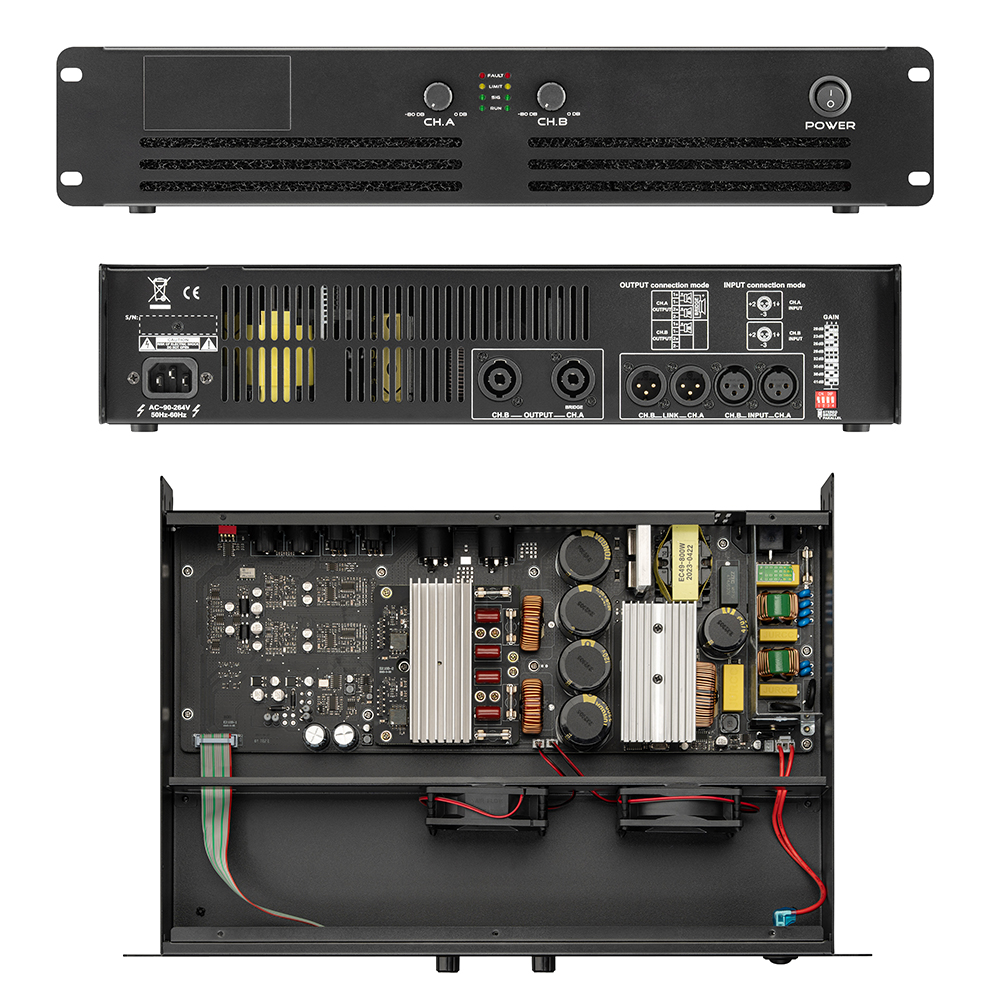
GaN (Gallium Nitride) is a semiconductor material used in place of silicon in amplifier transistors. It switches faster and handles heat more efficiently, allowing class D amplifiers to deliver more power from a smaller, lighter chassis.
GaN-based amplifiers often carry a higher upfront cost due to the semiconductor material and manufacturing process. However, lower power consumption and reduced cooling requirements can offset this cost over time, particularly for amplifiers run for extended hours.
The main risks involve compatibility with existing rack space and cabling, and ensuring the manufacturer provides adequate protection circuitry (short-circuit, DC fault, RF interference). Sourcing from an established manufacturer with documented specifications reduces this risk significantly.
GaN amplifiers are generally built for high-output applications like large festivals, stadiums, and touring setups. For smaller venues with modest power requirements, a traditional Class H or standard class D amplifier may be a more cost-effective alternative.
Alternatives include traditional silicon class D amplifiers, Class H amplifiers, and transformer-based designs. Each offers different trade-offs between cost, power density, and thermal efficiency, so the right choice depends on venue size, budget, and duration of use.


