
Views: 0 Author: Site Editor Publish Time: 2026-08-24 Origin: Site


Stage power amplifiers typically range from $100 for entry-level models to $3,000+ for professional-grade units. Price depends on output power (measured in watts), channel count, amplifier topology (Class AB, H, or D), and build quality. High-density 4-channel models like the AUWAY PS41300 sit in the mid-to-upper tier, targeting large venues and touring applications.
Budgeting for a stage power amplifier is harder than it sounds. The market spans a huge range of price points, and the "right" amplifier for a 200-seat theater looks nothing like the right one for a stadium or a megachurch running eight-hour worship services. Pay too little, and you risk distortion, overheating, or outright failure mid-show. Overspend on specs you don't need, and you've wasted money that could have gone toward better speakers or signal processing.
This guide breaks down what stage power amplifiers actually cost, what drives those prices, and how to match your budget to your real-world needs.
Before looking at price tiers, it helps to understand what you're actually paying for. Three factors account for most of the cost variation between models.
Power output—measured in watts per channel at a given impedance (typically 4Ω or 8Ω)—is the most direct cost driver. A 2-channel amplifier delivering 2x400W at 8Ω costs significantly less than a 4-channel unit putting out 4x1300W at 8Ω. More watts require more transistor pairs, larger transformers, heavier capacitors, and better cooling systems—all of which add cost.
Channel count also matters. A 4-channel audio power amplifier lets you run main speakers, stage monitors, and subwoofers from a single rack unit. That flexibility commands a premium but often saves money overall, since you're buying one unit instead of two or three.
Amplifier topology—the circuit design that converts power into audio signal—has a major impact on both price and operating cost:
Class AB: The traditional standard. Reliable and well-understood, but runs hot and wastes energy as heat. Generally the most affordable to buy, but expensive to run over time.
Class H: A step up from Class AB. Class H designs adjust the supply voltage dynamically based on signal demand, cutting energy waste significantly. Better suited for extended use (all-day events, installed systems). Priced higher than Class AB but offers lower operating costs.
Class D / Digital: Highly efficient and lightweight. Popular for touring rigs where weight matters. Can be cost-competitive with Class H at equivalent wattages, though audio purists sometimes prefer the headroom of analog topologies for critical applications.
This is where price differences between similarly specced amplifiers often reveal themselves. The number of transistor pairs per channel, the quality of capacitors, the type of transformer, and the protection circuitry all affect reliability and sound quality under load. A professional-grade stage power amplifier intended for touring or installation will use more robust components than a budget unit with the same rated wattage.
At this price point, you'll find 2-channel amplifiers typically rated between 200W and 600W per channel at 4Ω. These units suit small venues, rehearsal spaces, and low-demand installations. Expect Class AB designs, basic protection features, and lighter build quality. They work fine for predictable, low-stress environments—but aren't built for continuous high-output use.
This is where the professional audio amplifier market gets interesting. Mid-range units often feature Class H or Class D topologies, 4-channel configurations, and more sophisticated protection systems (overheat muting, DC fault protection, output relay switching). Power output in this tier ranges roughly from 4x600W to 4x1200W at 8Ω.
These amplifiers suit mid-sized venues, houses of worship, and semi-permanent installations where reliability matters but full touring-grade specs aren't required.
At the top of the market, you get amplifiers engineered for demanding, continuous-use environments: stadiums, large concert venues, touring monitor rigs, and megachurch systems. These units push 4x1300W and above at 8Ω, use more transistor pairs per channel for cleaner peak handling, and include variable-speed smart cooling systems that adapt to workload.
The AUWAY PS41300, for example, delivers 4x1300W at 8Ω (or 4x1950W at 4Ω) in stereo mode, and 2x3900W at 8Ω in bridged mono—enough headroom to power large subwoofer arrays or main PA clusters without a second amplifier. It uses 18 transistor pairs per channel (compared to the 12–16 found in standard professional amplifiers), 16 high-grade capacitors, and a Class H topology optimized for extended use. Units in this class are priced to reflect genuine engineering investment, not just marketing.
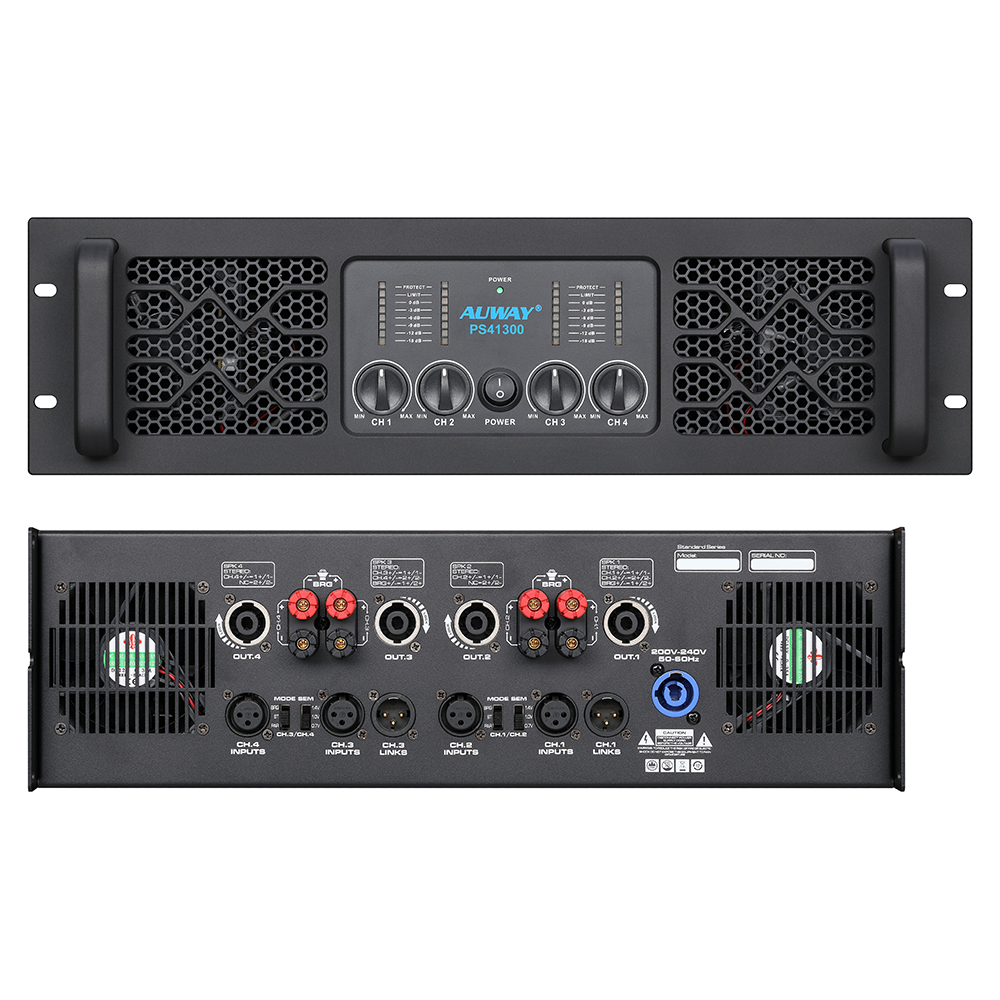
Small to medium venues (under 500 seats) rarely need more than 4x800W at 8Ω. A mid-range 4-channel audio power amplifier covers mains, monitors, and fill speakers without straining the budget. For venues over 1,000 seats, or for outdoor events with significant SPL demands, the math shifts quickly—you need headroom, and headroom costs money.
For events lasting 2–3 hours, a Class AB amplifier may suffice. For all-day conferences, worship services running 8+ hours weekly, or installed systems that run continuously, Class H efficiency pays for itself over time through lower electricity bills and reduced heat stress on components.
If you're powering large subwoofers or high-wattage main arrays, bridged mono mode doubles your available power from a single unit. The AUWAY PS41300's bridged mono output of 2x3900W at 8Ω means a single rack unit can handle jobs that would otherwise require two separate amplifiers—a meaningful cost saving at the system level.
A professional-grade stage power amplifier suitable for large venues typically costs between $800 and $2,500. Entry-level models for smaller applications start around $100–$400, while top-tier touring and installation units can exceed $3,000.
Class H audio power amplifiers cost more upfront than Class AB designs, but the efficiency gains make them more economical for high-usage environments. Class H designs reduce energy waste by adjusting supply voltage to match signal demand, which also generates less heat—extending component lifespan and reducing cooling costs over time.
For small venues (under 200 people), 2x400W–2x800W at 8Ω is usually sufficient. Medium venues (200–500 people) typically need 4x800W–4x1000W at 8Ω. Large venues, stadiums, and touring applications benefit from 4x1300W and above, with bridged mono capability for high-wattage subwoofers.
THD+N stands for Total Harmonic Distortion plus Noise. It measures how much the amplifier alters the audio signal. Lower numbers mean cleaner sound. Professional-grade amplifiers like the AUWAY PS41300 achieve THD+N of less than 0.05%, which is considered studio-grade clarity—meaning vocals, speech, and musical detail stay clean even at maximum output.
The cheapest stage power amplifier is rarely the most cost-effective one. Factor in energy consumption, expected lifespan, repair costs, and the real-world consequences of equipment failure during a live event—then the value of investing in a well-built, properly specced unit becomes clear.
Whether you're equipping a small venue or specifying a large-scale installation, the right audio power amplifier is the one that matches your power, channel, and duty-cycle requirements without leaving you exposed at the worst possible moment. Visit cn-auway.com to explore AUWAY's full range of professional stage power amplifiers, or contact their team directly for a custom quote.


