
Views: 0 Author: Site Editor Publish Time: 2026-09-10 Origin: Site


A digital amplifier (also called a Class D or switching amplifier) uses high-speed switching transistors instead of continuously operating analog components to amplify audio signals. This design delivers higher efficiency, less heat, and a lighter chassis than traditional analog amplifiers, while still providing massive power output—making digital amplifiers the standard choice for touring rigs, subwoofer arrays, and large-scale sound reinforcement.
Anyone shopping for a subwoofer amplifier or a professional audio power amplifier eventually runs into the term "digital amplifier." It sounds like it should mean something with digital signal processing, but that's not quite right. The distinction is actually about how the amplifier's output stage handles power, and understanding it can save you from an expensive mismatch between your speakers and your rig.
This guide breaks down what a digital amplifier actually is, how it compares to older analog designs, and how to choose the right one for your venue—whether that's a nightclub, a touring festival stage, or a fixed installation.
A digital amplifier, more accurately known as a Class D amplifier, converts the input audio signal into a rapid series of on/off pulses (a process called pulse-width modulation). These transistors switch fully on or fully off rather than operating in a linear, continuously variable state like Class A or Class AB designs. Because the transistors aren't wasting energy in a partially-on state, digital amplifiers run cooler and convert a much higher percentage of input power into usable output.
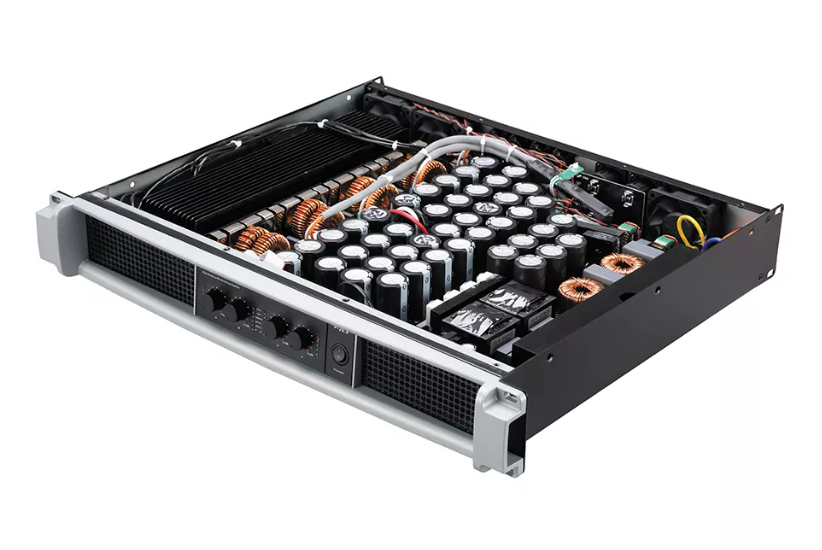
This is why a digital switching amplifier can pack thousands of watts into a compact, lightweight chassis. AUWAY's P54.2, for example, delivers 2x2300W at 8Ω in a 1.5U rack space weighing just 8.9kg—a power-to-weight ratio that would be difficult to achieve with older analog topologies.
Feature | Digital (Class D) Amplifier | Analog (Class AB/H) Amplifier |
|---|---|---|
Efficiency | Typically 85-92%+ | Usually 50-70% |
Weight | Lighter (compact heatsinks, smaller transformers) | Heavier (large transformers, bigger heatsinks) |
Heat Output | Low | Moderate to high |
Power Density | Very high (more watts per rack unit) | Lower |
Sound Character | Precise, transparent | Often described as "warm" |
Best For | Touring, subwoofers, high-power installs | Vocal-critical or boutique installs |
Choose a digital amplifier if you need maximum power in minimal rack space, or if you're running subwoofers where raw output matters more than subtle tonal coloration. Choose an analog transformer-based amplifier if you're prioritizing a specific sonic character for vocal or musical applications, and space or weight isn't a constraint.
Subwoofer applications demand huge amounts of current to move large speaker cones, and digital amplification is particularly well-suited to this job. Take the D2400 subwoofer amplifier as an example: it's a 2-channel Class D unit delivering 2x2400W at 8Ω, 2x4100W at 4Ω, and 2x6300W at 2Ω, all within a slim 1U chassis weighing just 9kg. It uses PFC (power factor correction) technology to maintain stable output across a wide voltage range (90V-265V), which matters enormously for touring rigs that get plugged into unpredictable power sources across different venues and countries.
Because the D2400 doesn't need to reproduce the full audible spectrum with delicate nuance—just deliver low-frequency punch—the Class D design's efficiency advantages come with essentially no compromise for this use case.
A professional subwoofer amplifier isn't just about wattage. It needs the protection circuitry, connector standards, and thermal management to survive nightly load-in/load-out on tour or continuous operation at a fixed installation. Look for:
PFC power supplies that tolerate voltage fluctuations (90-265V is a common professional range)
Speakon connectors for secure, road-worthy speaker connections
Comprehensive protection circuits: short circuit, DC fault, overheat, and output relay switching
High damping factor (the D2400 specs >400) for tight, controlled bass response
Low THD+N (under 0.05% in the D2400's case) to keep the low end clean at high output
Some applications call for amplification well beyond what a single-rack-unit subwoofer amp provides. Stadiums, festival main stages, and 10,000+ capacity venues often need a digital switching amplifier capable of driving entire speaker arrays from one unit. AUWAY's FP20000Q is a good illustration: this 4-channel Class D amplifier delivers 4x4400W at 4Ω, and up to 2x13,000W when bridged at 4Ω, all in a 2U rack chassis weighing 15kg.
Notably, the FP20000Q intentionally omits built-in DSP. That's not an oversight—it's a design choice for audio engineers who prefer to run external DSP units (from brands like DiGiCo or Allen & Heath) for precise venue tuning, without any onboard processing coloring the signal first. If you're building a rig where an outboard processor already handles EQ and crossover duties, this pure-amplification approach avoids redundant signal paths.
Application | Recommended Amplifier Type | Example |
|---|---|---|
Mobile DJ / small-to-mid venues | Compact, lightweight 2-channel digital amp | P54.2 (2x2300W @8Ω, 1.5U, 8.9kg) |
Dedicated subwoofer driving | High-current 2-channel Class D subwoofer amp | D2400 (2x2400W @8Ω, PFC power supply) |
Stadiums, festivals, large touring rigs | Ultra-high-power 4-channel digital amp, no onboard DSP | FP20000Q (4x4400W @4Ω, bridgeable to 13,000W) |
Precise venue tuning with external DSP | Pure amplification design that pairs with outboard processors | FP20000Q |
The decision generally comes down to three questions: how much power do you actually need, how much rack space and weight can you afford, and whether you want built-in signal processing or plan to handle that externally.
Yes. "Digital amplifier" is the common industry term for what's technically called a Class D amplifier—one that uses high-speed switching transistors rather than continuously variable analog output stages.
Not meaningfully in modern designs. Early Class D amplifiers had a reputation for sounding less refined, but current designs—like those using PFC power supplies and high sampling rates—achieve THD+N figures below 0.1%, matching or exceeding many analog amplifiers.
Efficiency and power density. A digital switching amplifier converts more input power into usable output and wastes less as heat, so it can deliver significantly more wattage in a smaller, lighter chassis.
Some can be run full-range, but subwoofer amplifiers like the D2400 are optimized for low-frequency output and current delivery. For full-range duty, a dedicated full-range or multi-channel digital amplifier is usually a better fit.
No. Onboard DSP is a convenience feature, not a requirement. Amplifiers like the FP20000Q skip it entirely so engineers can pair the amp with dedicated outboard processing for more precise control.
Digital amplifiers have become the default choice across live sound, touring, and installation work for good reason: they deliver more power per rack unit, run cooler, and hold up to the demands of repeated setup and teardown. The right choice still depends on your specific application, whether that's a compact 2-channel unit for mobile gigs, a dedicated subwoofer amplifier for low-end authority, or an ultra-high-power 4-channel unit for stadium-scale sound reinforcement.
If you're planning your next system and want to match amplifier specs to your speakers and venue size, reach out to AUWAY's team for guidance on selecting the right model from their digital amplifier lineup.


