
Views: 0 Author: Site Editor Publish Time: 2026-02-05 Origin: Site


You came here to understand a Class TD Power Amplifier.We will keep it practical, not mystical.We will map the signal path, plus the control path.We will also track performance, using repeatable measurements.
What is a Class TD Power Amplifier, in simple terms?
How do analog stages and digital control cooperate?
Why do tracking rails change heat, headroom, efficiency?
What does “transformer-based” mean in modern power amps?
How do we test THD+N, IMD, efficiency, thermal limits?
Which design tradeoffs affect EMI, noise, stability?
Many readers mix Class TD and Class D.We will separate them early, then compare them fairly.We will also reuse ideas from high-frequency transformer coupling.It helps explain isolation, modulation, magnetic limits.
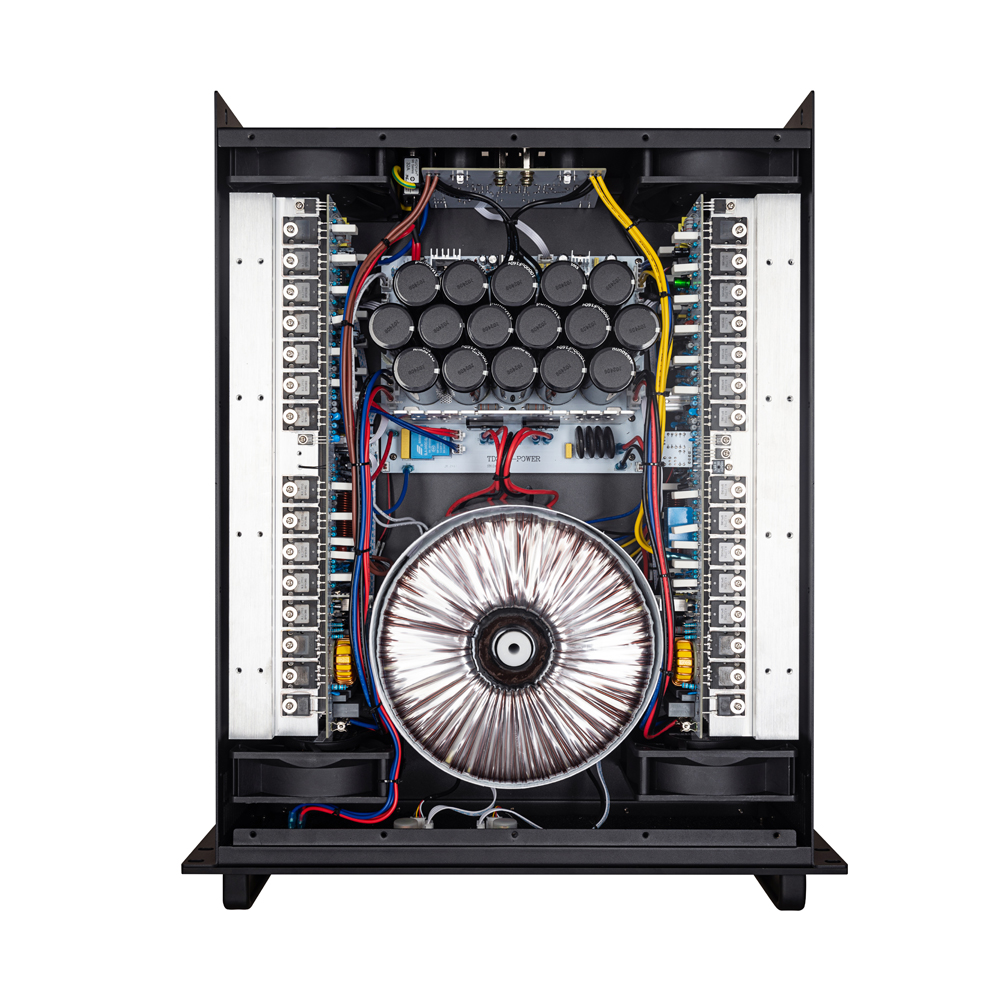
A Class TD Power Amplifier aims for high efficiency — a core requirement for compact, high-power professional audio equipment — while also delivering "clean" analog audio behavior that meets the strict sound quality demands of pro-audio scenarios like live festivals, studio monitoring, and fixed installation systems.Here is the core idea:The supply rails track the audio signal envelope.So, the output devices drop less unused voltage.Less unused voltage means less heat, often much less — a game-changer for rack-mounted systems where space for cooling is limited and thermal buildup can lead to reliability issues or performance derating.
Tracking rail: a supply rail that moves based on signal demand. Core to Class TD design, it eliminates redundant voltage overhead by matching the rail voltage to the instantaneous needs of the audio output, rather than staying fixed at a maximum level.
Headroom: extra voltage margin to avoid clipping on peaks. Critical for handling transient audio bursts (like drum strikes or vocal crescendos) without distortion, and Class TD’s tracking mechanism optimizes this margin to avoid wasting energy on unused headroom.
Control plane: sensing, logic, protection, monitoring. The "brain" of the Class TD amp that manages rail tracking, device safety, and system telemetry, often blending analog and digital circuitry.
Audio plane: gain stages, drivers, output devices. The "heart" that processes and delivers the audio signal, with a focus on linear, low-distortion performance to preserve sound quality.
| Topology | Main audio behavior | Rail strategy | Typical strengths | Typical pain points |
|---|---|---|---|---|
| Class AB | Linear output devices | Fixed rails | Simple, predictable distortion shaping, mature technology, low EMI at audio bands | Heat at mid power, heavier cooling requirements, lower power density, higher energy waste |
| Class D | Switching output stage | Fixed rails, switching output | High efficiency, compact power density, low thermal output, ideal for portable gear | EMI control challenges, sensitive to PCB layout, requires complex output filtering, PWM residue can affect sound quality |
| Class H / G | Linear output devices | Stepped rails or dual rails | Lower heat vs fixed rails (Class AB), retains linear audio behavior, simpler than Class TD | Rail switching artifacts if poorly managed, limited efficiency gains vs continuous tracking, step transitions can introduce distortion |
| Class TD Power Amplifier | Analog audio path emphasis | Tracking rails, fast control | High efficiency, high power density, strong headroom use, low distortion (analog audio path), minimal thermal buildup at mid power | Rail loop design complexity, sensing noise susceptibility, EMI coupling risks between switching rails and analog audio stages, higher design and calibration overhead |
Some pro-audio designs also stress consistent power under tough mains conditions.It matters during festivals (unstable generator power), long cable runs (voltage drop, reactive loads), hot racks (limited airflow, thermal stacking), and weak generators (mains sag, voltage fluctuations) — scenarios where Class TD’s robust rail tracking and efficiency shine.
We will keep audio and control separated (a critical design discipline to avoid noise coupling), but note that they are deeply interdependent for optimal performance.
Input stage: sets noise, headroom, common-mode behavior. Typically a balanced differential stage to reject ground noise and interference (critical for pro-audio installations with long cable runs), and it establishes the initial low-noise foundation for the audio signal.
Gain staging: prevents clip inside earlier stages. Carefully calibrated to ensure each stage operates within its linear range, avoiding internal distortion before the signal reaches the output stage — especially important since Class TD’s rail tracking relies on accurate sensing of the signal’s envelope.
Driver stage: moves current into output device gates or bases. Buffers the low-power audio signal to provide sufficient current to drive the high-power output devices, maintaining linearity while avoiding signal degradation.
Output stage: delivers current into the load (speaker). Retains linear operation (unlike Class D’s switching output) to preserve audio purity, with its power dissipation minimized by the tracking rails that match the signal’s envelope.
Rail tracking needs sensing, then actuation — speed and accuracy here are non-negotiable to avoid audible artifacts.Sensing estimates required rail voltage per moment (typically capturing the signal’s envelope, peak, or predictive look-ahead to handle transients).Actuation changes SMPS duty, rail converter behavior, or both (adjusting the switched-mode power supply (SMPS) to deliver the exact voltage needed by the output stage, with minimal latency).
Many TD-style explanations keep audio outside the switching output concept — this is a deliberate design choice with tangible benefits.It can reduce PWM-style residue on the speaker line (a common pain point with Class D amplifiers, which requires complex filtering to mitigate), preserving the smooth, low-distortion behavior of linear amplifiers (like Class AB) while gaining the efficiency of switching power supplies.Still, switching noise exists nearby (from the SMPS and rail tracking modulator), so layout discipline (separating analog and switching domains, tight grounding, and noise filtering) matters immensely to avoid contaminating the clean audio path.
“Transformer-based” can mean several real things in modern Class TD amplifiers, but it rarely refers to the large, heavy output transformers of vintage tube amps.It usually points at the SMPS transformer first — a compact, high-frequency component that is central to the amplifier’s efficiency and isolation.
SMPS isolation transformer: power transfer, galvanic isolation. The core transformer in the switched-mode power supply, it converts the incoming AC mains voltage to high-frequency AC, then steps it up/down to the required voltage range for the tracking rails. Galvanic isolation separates the mains power from the audio circuitry, improving safety and reducing ground loop noise.
Coupled magnetics: auxiliary windings, current sensing support. Integrated with the SMPS transformer, these provide additional functionality like auxiliary power for control circuitry, current feedback for SMPS regulation, and noise shaping to reduce EMI from switching edges.
Signal isolation transformer: input isolation for ground control. Used in the audio input stage (optional but common in pro-audio) to further reject ground loops and interference, ensuring the low-level audio signal remains clean before it enters the gain stages.
High-frequency switching (typically tens to hundreds of kilohertz) enables smaller magnetics — a key factor in achieving high power density in Class TD amplifiers.It also pushes switching artifacts away from low-frequency audio bands (20 Hz to 20 kHz), reducing the risk of audible noise and simplifying filtering to remove switching residue.
Transformer coupling passes power across isolation barriers (critical for safety and noise rejection) without the need for direct electrical connections.It also supports modulation concepts, feedback sensing, noise shaping — all essential for the fast, stable rail tracking that defines Class TD.Those ideas help when we analyze rail tracking dynamics, especially under bursts (like loud bass transients), where the transformer must quickly transfer additional energy to the rails to maintain headroom and avoid clipping.
Which switching frequency balances magnetics size, switching loss? (Higher frequencies reduce magnetics size but increase switching losses; lower frequencies reduce switching losses but require larger magnetics — a classic tradeoff, typically optimized for the amplifier’s power rating and thermal constraints.)
How do leakage inductance, stray capacitance affect EMI? (Leakage inductance causes voltage spikes on switching edges, while stray capacitance provides a path for high-frequency noise to couple into other circuits — both are major sources of EMI, and mitigated by careful transformer design and PCB layout.)
How do we route high-di/dt loops near low-noise input stages? (We don’t — high-di/dt loops (from transformer switching and SMPS outputs) are kept as far as possible from low-noise input stages, with physical barriers and separate grounding planes to avoid noise coupling.)
Which thermal limits hit first, core or copper? (Copper loss (I²R) typically dominates at lower switching frequencies and high currents, while core loss (hysteresis and eddy currents) dominates at higher frequencies — the first to reach thermal limits depends on the transformer’s design and the amplifier’s operating conditions, with both requiring careful thermal management.)
Hybrid design means two worlds (analog audio, digital control) sharing one box — the key to successful Class TD design is clean boundaries, plus disciplined crossings between these two domains to avoid noise and performance degradation.
Analog circuitry is retained for critical audio functions where linearity and low noise are paramount:
Low-noise input amplification, balanced receiver stages. (Analog differential stages excel at rejecting common-mode noise and maintaining a low noise floor, which is critical for preserving the integrity of low-level audio signals.)
Core audio gain control, unless DSP handles it. (Analog gain stages provide smooth, distortion-free gain adjustment without the latency or quantization noise of digital processing.)
Driver and output linearity mechanisms. (Linear analog output stages deliver the clean, predictable audio behavior that pro-audio applications demand, avoiding the PWM residue of digital switching outputs.)
Digital circuitry is used for control, monitoring, and system management functions where repeatability, flexibility, and calibration are key:
Telemetry: temperature, rail voltages, current, clip counters. (Digital sensors and ADCs provide accurate, repeatable measurements that can be logged, transmitted, or used for real-time system adjustments.)
Protection logic: over-current, DC detect, thermal derating. (Digital logic can implement complex, adaptive protection algorithms that respond faster and more consistently than analog circuitry, reducing the risk of device failure.)
Rail setpoints: tracking behavior, headroom targets, hard limits. (Digital control allows for precise calibration of the rail tracking loop, including adaptive headroom margins and limits that can be adjusted for different load conditions or application scenarios.)
System UX: presets, networking, control panels, logging. (Digital circuitry enables user-friendly features like remote monitoring, presets for different speaker systems, and fault logging — critical for professional installations and live events.)
Analog blocks face scaling pressure, noise sensitivity, process variation (components can drift with temperature and age, affecting performance).Digital control adds repeatability, calibration, field updates (digital calibration can compensate for analog drift, and field updates can improve performance or fix bugs without physical modifications).Still, it can inject noise if partitioning gets sloppy (digital clocks and switching signals are major noise sources, and poor layout can cause them to couple into the analog audio path, degrading sound quality).
To minimize noise and maximize performance when crossing between analog and digital domains, follow this practical checklist:
Keep sensing lines short, then filter them near the ADC. (Short lines reduce the risk of picking up noise, and local filtering removes high-frequency artifacts before they reach the digital converter.)
Use differential sensing for rails and current shunts. (Differential sensing rejects common-mode noise, improving the accuracy of measurements used for rail tracking and protection.)
Isolate digital clocks from input stage nodes. (Digital clocks operate at high frequencies and can couple into the low-noise input stage — use physical separation, grounding planes, or shielded cabling to isolate them.)
Route power ground returns away from small-signal references. (Power ground returns carry high currents and can create voltage drops that affect analog reference voltages — use separate ground planes for power and small-signal analog, with a single point of connection (star grounding) to avoid ground loops.)
Scan rail tracking noise during silence and low-level tones. (Silence and low-level tones are the most sensitive to noise — testing during these conditions reveals any coupling between the digital/switching domains and the analog audio path.)
Control loops decide if a Class TD Power Amplifier feels “solid” (consistent performance, no audible artifacts) or “nervous” (pumping, ringing, random protection trips).We usually juggle several loops at once.They interact, even if we pretend they do not — and this interaction is one of the biggest challenges in Class TD design.
Audio feedback loop: it keeps gain linear, reduces distortion, improves damping. The primary loop for audio quality, it compares the output signal to the input signal (or a reference) and adjusts the gain stages to minimize error, ensuring consistent performance across different loads and frequencies.
Rail tracking loop: it moves supply rails to follow output demand. The defining loop of Class TD, it senses the audio signal’s envelope and adjusts the SMPS to deliver the required rail voltage, balancing efficiency and headroom to avoid clipping and minimize heat.
SMPS regulation loop: it stabilizes rail energy across load swings. Works in tandem with the rail tracking loop to maintain the desired rail voltage, even when the output load changes rapidly (like during a bass transient), and to reject fluctuations in the incoming mains power.
Protection loop: it limits current, temperature, DC, clip events. Monitors critical parameters (output current, device temperature, rail voltage) and takes action (reduces gain, shuts down the output, derates power) to prevent damage to the amplifier or the connected speakers.
Cooling loop: it drives fans, derates power, prevents hotspots. Monitors thermal conditions and adjusts fan speed (or derates power if cooling is insufficient) to maintain safe operating temperatures, critical for high-power, compact amplifiers.
Audio feedback wants a calm supply (stable, low-ripple rails to maintain linearity and low distortion).Rail tracking wants fast movement (quickly adjusting the rails to follow the audio signal’s envelope, maximizing efficiency).SMPS control wants stable energy flow (minimizing voltage fluctuations and switching noise to maintain regulation).Put them together, you get a tug-of-war — optimizing one loop can degrade the performance of another, requiring careful tuning and tradeoffs to achieve balance.
| Symptom | What we often see | Likely root cause | Quick check |
|---|---|---|---|
| Buzz or hash at low level | Noise rises near silence | Rail ripple couples into small-signal nodes | Probe rails (look for high-frequency ripple), then input reference (look for the same ripple — indicating coupling) |
| “Pumping” on bass hits | Audible envelope movement, slight distortion on transients | Tracking loop too slow (can’t keep up with the signal’s envelope), headroom too small (rails can’t rise fast enough to avoid clipping) | Compare rail waveform vs output envelope (using an oscilloscope) — a slow loop will show a lag between the rail and the envelope |
| Random protection trips | Mute events, then auto recover, with no obvious overload | Sensing picks up switching noise (false triggers for over-current or over-voltage protection) | Add a small RC filter to the sensing lines and retest — if trips stop, noise was the root cause |
| Oscillation at specific loads | Ringing on transients, hot devices, distorted output | Phase margin collapses near reactive loads (speakers are reactive, not purely resistive, and can cause the audio or rail tracking loop to become unstable) | Test 4 Ω + capacitive network (emulates a speaker’s reactive impedance) and monitor for ringing — adjust loop compensation to increase phase margin |
To ensure robust stability across all operating conditions, follow this validation checklist:
Check phase margin across hot, cold, nominal temperature. (Component values drift with temperature, which can affect loop stability — test at extreme temperatures to ensure margins are sufficient.)
Test 2 Ω, 4 Ω, 8 Ω resistive loads, then reactive loads. (Speakers come in different impedances and are reactive — test across a range of loads to ensure stability and consistent performance.)
Run tone bursts, not only steady sine sweeps. (Tone bursts emulate real audio transients and reveal stability issues that steady sine waves may not — critical for pro-audio applications.)
Observe rail tracking error during fast transients. (Fast transients (like 10 ms bass bursts) are the most challenging for the rail tracking loop — measure the error between the desired rail voltage and the actual voltage to ensure it stays within acceptable limits.)
Log protection flags, rail voltages, per event. (Logging helps identify intermittent issues and correlate protection trips with specific operating conditions, simplifying debugging.)
Performance claims sound easy.Proof needs a test plan — one that delivers repeatable numbers, plus honest graphs, to validate the amplifier’s performance against its specifications and real-world requirements.
These metrics are the gold standard for evaluating audio quality, and they are critical for Class TD amplifiers to prove that their efficiency gains do not come at the cost of sound quality:
THD+N vs power: it shows distortion rise near clip. Total Harmonic Distortion plus Noise (THD+N) measures the amount of distortion and noise added to the output signal relative to the fundamental frequency — a low, flat THD+N curve across most of the power range indicates high audio quality, with a sharp rise near clip indicating the amplifier’s maximum linear output.
IMD: it reveals nonlinearity under complex tones. Intermodulation Distortion (IMD) measures the distortion created when two or more frequencies are applied to the amplifier (emulating real music, which is a complex mix of frequencies) — low IMD indicates that the amplifier can handle complex signals without creating unwanted intermodulation products.
Noise floor: it matters in installs, also studio use. The noise floor is the level of inherent noise in the amplifier’s output when no input signal is present — a low noise floor is critical for studio monitoring and fixed installations where low-level signals need to be reproduced clearly.
Frequency response: it shifts under load, cable, output network. Frequency response measures the amplifier’s gain across the audio band (20 Hz to 20 kHz) — a flat, consistent frequency response across different loads and cable lengths indicates that the amplifier can reproduce all audio frequencies accurately.
Crosstalk: it exposes layout, grounding, PSU coupling. Crosstalk measures the amount of signal leakage between channels (in multi-channel amplifiers) — low crosstalk indicates that the amplifier’s layout and grounding are well-designed, with minimal coupling between channels.
A Class TD Power Amplifier should waste less power at mid output (the most common operating range for real music) — so, measure efficiency across a sweep, not one point, to fully validate its efficiency gains.
| Test | Signal | Why it matters | What to record |
|---|---|---|---|
| Efficiency sweep | 1 kHz sine | Baseline comparison (industry standard for efficiency testing, allows direct comparison with other amplifier topologies) | Input power (Pin), output power (Pout), heat rise (device case temperature, heatsink temperature), efficiency (η = Pout / Pin × 100%) |
| Program power | Shaped noise (emulates real music, with a dynamic range and frequency distribution similar to typical audio) | Real music load (most amplifiers operate at mid power with dynamic transients, not steady sine waves — this test reflects real-world efficiency) | Average rails voltage, thermal steady state (temperature after 30+ minutes of operation), average input power, average output power |
| Idle draw | Silence | Install energy cost (amplifiers may be idle for long periods in installations or live events — low idle draw reduces energy costs and thermal buildup) | Watts (idle input power), rail ripple (high-frequency noise on the rails during idle), fan state (off, low speed, high speed) |
| Thermal stress | Pink noise (flat power across the audio band, maximizing thermal load) | Heat soak behavior (tests the amplifier’s thermal management system under maximum load, revealing hotspots and derating points) | Hotspot temperature (hottest device on the PCB), derate point (power level where the amplifier starts to reduce gain to avoid overheating), time to thermal steady state |
Rail tracking is the “TD” signature — so, we quantify it to validate that the rail tracking loop is performing optimally, balancing efficiency, headroom, and speed.
Tracking error: rail minus required output plus guard band. The difference between the actual rail voltage and the desired rail voltage (output envelope plus headroom guard band) — a small, consistent tracking error indicates that the loop is accurate and efficient.
Tracking speed: rise, fall time, overshoot, settling. Measures how quickly the rail voltage can respond to changes in the audio signal’s envelope — fast rise/fall times (with minimal overshoot and settling time) are critical for handling transients without clipping or pumping.
Headroom policy: how it chooses the guard band per moment. The algorithm that determines the amount of headroom (guard band) added to the rail voltage — an adaptive policy that adjusts headroom based on the signal’s dynamics (more headroom for fast transients, less for steady signals) optimizes efficiency and performance.
Artifact scan: FFT around low-level tones, plus silence. Uses a Fast Fourier Transform (FFT) to look for unwanted artifacts (like switching noise or tracking loop pumping) in the output signal — a clean FFT (with no spurious peaks) indicates that the rail tracking loop is not introducing audible artifacts.
Switching edges (from the SMPS and rail tracking modulator) spray energy everywhere — this high-frequency energy can cause electromagnetic interference (EMI) that disrupts other electronic equipment (like wireless microphones, mixers, or computers) and can cause the amplifier to fail compliance with regulatory standards (like FCC Part 15 or CE EN 55032).We can tame it, if we plan early — EMI mitigation is most effective when it is integrated into the design from the start, not added as an afterthought.
EMI in Class TD amplifiers originates from four primary sources, all related to the high-speed switching of the SMPS and rail tracking loop:
SMPS switch nodes, fast dv/dt edges. (The switch nodes in the SMPS experience rapid voltage changes (dv/dt) that create high-frequency noise, which can radiate or couple into other circuits.)
Rail tracking modulation edges, burst patterns. (The rail tracking loop’s modulation creates burst-mode switching noise, which can be more difficult to filter than continuous switching noise.)
Gate drive loops, high di/dt returns. (The gate drive circuits for the SMPS switches carry high, fast-changing currents (di/dt) that create magnetic fields, which can couple into nearby analog circuits.)
Cable harnesses, long speaker lines, chassis seams. (Cables and chassis seams act as antennas, radiating the high-frequency noise created by the SMPS and rail tracking loop into the surrounding environment.)
These practical mitigation steps are often overlooked but are critical for reducing EMI and ensuring RF coexistence:
Keep “dirty” power loops tight, compact, predictable. (High-current, high-frequency power loops (from the SMPS and rail outputs) should be kept as small as possible to minimize their radiated emissions — tight loops reduce the area of the magnetic field, which reduces the amount of radiated noise.)
Give sensitive audio nodes a quiet reference island. (Create a dedicated, isolated grounding plane (reference island) for the low-noise audio input stages, separate from the power and switching grounding planes, to protect them from noise coupling.)
Use differential sensing, filter near ADC pins. (Differential sensing rejects common-mode noise, and local filtering near the ADC pins removes high-frequency artifacts before they can be digitized and processed.)
Control return paths, not only forward traces. (Return paths are just as important as forward traces — uncontrolled return paths can create large loops that radiate noise, so always design the return path alongside the forward trace.)
Place common-mode chokes where cables leave the box. (Common-mode chokes filter out common-mode noise on cables (like speaker cables or mains cables) before it can radiate into the environment, and they should be placed as close as possible to where the cable exits the amplifier chassis.)
We can test coexistence fast — without expensive lab equipment — to validate that the amplifier is not creating harmful EMI that disrupts other equipment.Bring a spectrum analyzer, plus a near-field probe (to detect radiated noise close to the amplifier).Also bring wireless mic gear (a common victim of EMI in live events), run it near the amp.Then sweep output power, watch RF noise peaks move — if the wireless mic experiences dropouts or static when the amplifier’s power is increased, EMI is a problem.
| What we test | Tool | Pass signal | Fail signal |
|---|---|---|---|
| Radiated peaks | Near-field probe | Stable spectrum, low spikes (no spikes above the background noise floor, or spikes that are well below regulatory limits) | Spikes jump on bass hits (burst-mode noise from the rail tracking loop, which can disrupt wireless equipment) |
| Conducted noise | LISN + analyzer (Line Impedance Stabilization Network, which provides a standardized impedance for measuring conducted noise on the mains cable) | Margin vs limits (conducted noise levels are well below the regulatory limits, with sufficient margin for temperature and component drift) | Limit edge, then fail on transients (conducted noise is at the edge of the regulatory limit, and exceeds it during transients like bass bursts) |
| Audio noise coupling | Audio analyzer FFT | Quiet noise floor (no spurious peaks in the audio band, with a noise floor well below the minimum output level of the amplifier) | Switching tones leak into band (high-frequency switching noise from the SMPS is coupling into the analog audio path, creating audible artifacts) |
Efficiency helps, yet heat still wins if we ignore density — compact chassis, high power, plus hot ambient rooms (like rack rooms or outdoor festivals) can create hotspots that lead to component failure, performance derating, or shortened lifespan.Thermal design is not just about adding a heatsink — it is about understanding where the heat is generated, how it is transferred, and how to remove it efficiently to ensure reliable operation.
Heat in Class TD amplifiers comes from five primary sources of power loss — understanding this breakdown is critical for effective thermal design:
Output devices: conduction loss, switching loss, drive loss. (Even with tracking rails, the output devices still dissipate power — conduction loss (I²R) from the current flowing through the device, switching loss (from turning the device on and off, if it is a switching device), and drive loss (from the power required to drive the device’s gate or base).)
Magnetics: copper loss, core loss, leakage heating. (The SMPS transformer and coupled magnetics dissipate power — copper loss (I²R) from the current flowing through the windings, core loss (hysteresis and eddy currents) from the changing magnetic field in the core, and leakage heating from the energy lost to leakage inductance.)
Rectifiers: diode drop, recovery behavior, thermal cycling. (The rectifiers in the SMPS convert AC to DC, dissipating power from the diode forward voltage drop (Vf×I) and reverse recovery losses (for fast diodes), and thermal cycling (from repeated heating and cooling) can lead to fatigue and failure.)
Capacitors: ripple current heating, life reduction. (The electrolytic capacitors in the SMPS and rail filters carry high ripple currents, which dissipate power (I²×ESR, where ESR is Equivalent Series Resistance) and cause heating — high temperatures significantly reduce the lifespan of electrolytic capacitors.)
Fans: dust, bearing wear, acoustic limits. (Fans are critical for cooling compact amplifiers, but they are also a common point of failure — dust buildup can block airflow and cause overheating, bearing wear can lead to fan failure, and acoustic noise can be a problem in quiet installations (like studios).)
Think in blocks, then connect them in a chain — this simple thermal model helps you understand the heat flow from the source to the environment, and it helps you identify bottlenecks in the thermal path.
| Node | Main heat source | Thermal path | What we monitor |
|---|---|---|---|
| Output hotspot | Device loss (conduction, switching) | Junction → case → sink → air (the heat flows from the device’s semiconductor junction (hottest point) to the device case, then to the heatsink, then to the surrounding air via convection or forced air (fans)) | Case temp (device case temperature, measured with a thermocouple), sink temp (heatsink temperature, measured with a thermocouple or thermal sensor) |
| Transformer | Core + copper loss | Winding → core → potting → air (the heat flows from the transformer windings to the core, then to the potting material (if the transformer is potted), then to the surrounding air) | Core surface temp (transformer core surface temperature, measured with a thermocouple — the core is typically easier to access than the windings) |
| Cap bank | Ripple current heating (I²×ESR) | Can → PCB → air (the heat flows from the capacitor’s can (outer casing) to the PCB (via the capacitor’s leads), then to the surrounding air) | ESR drift (equivalent series resistance, measured with a capacitor tester — ESR increases as the capacitor heats up and ages), can temp (capacitor can temperature, measured with a thermocouple) |
These habits are critical for ensuring that Class TD amplifiers are reliable in real-world conditions, where they are subjected to harsh environments, varying loads, and long periods of operation:
Derate parts, especially electrolytics and MOSFETs. (Derating components (operating them below their maximum rated voltage, current, and temperature) increases their lifespan and reduces the risk of failure — a common derating guideline is to operate electrolytic capacitors at 70% of their rated voltage and MOSFETs at 80% of their rated current.)
Log faults, then correlate them to rail and temp traces. (Logging fault events (like protection trips, over-temperature warnings, or voltage fluctuations) and correlating them to rail voltage and temperature traces helps identify the root cause of intermittent issues and improves future designs.)
Plan dust paths, plan service intervals, plan fan redundancy. (Design the amplifier chassis to direct airflow through dust filters (to reduce buildup), schedule regular service intervals to clean filters and inspect fans, and use redundant fans (in high-reliability applications) to ensure cooling continues if one fan fails.)
Test mains sag, surge, brownout recovery behavior. (Mains power in real-world scenarios (like festivals or remote installations) is often unstable — test the amplifier’s performance during mains sag (low voltage), surge (high voltage), and brownouts (intermittent power) to ensure it can recover without damage or performance degradation.)
Let’s turn theory into a build plan — this step-by-step guide helps you translate the concepts of Class TD design into a practical, implementable process, from requirements definition to final verification.
Before starting the design, clearly define the requirements — this ensures that the final amplifier meets the needs of its intended application and avoids costly rework later:
Target watts per channel, plus bridge mode needs. (Define the maximum output power per channel (at 2 Ω, 4 Ω, 8 Ω loads) and whether the amplifier needs to support bridge mode (combining two channels to drive a single, high-power load).)
Lowest intended load, also complex impedance tolerance. (Define the lowest load impedance the amplifier will support (typically 2 Ω for pro-audio) and its ability to handle complex, reactive speaker impedances (which can vary significantly with frequency).)
Noise target, distortion target, output damping target. (Define the audio performance targets (THD+N, IMD, noise floor, frequency response) and the output damping factor (a measure of the amplifier’s ability to control the speaker’s cone motion, critical for tight bass response).)
Regulatory target: safety, EMC, environmental constraints. (Define the regulatory standards the amplifier must comply with (like FCC Part 15 (EMI), IEC 60950 (safety), or RoHS (environmental)) and any additional constraints (like size, weight, or power consumption).)
These key design choices define the amplifier’s architecture and performance, and they require careful tradeoffs to balance efficiency, audio quality, and reliability:
Tracking policy: continuous tracking or stepped rails. (Continuous tracking (smooth, real-time adjustment of the rails) offers the highest efficiency but is more complex to design; stepped rails (discrete voltage levels) are simpler to design but offer lower efficiency gains and may introduce switching artifacts.)
Headroom margin: small margin saves heat, yet risks clip. (A small headroom margin (5-10 V) maximizes efficiency but risks clipping on fast transients; a larger margin (15-20 V) reduces the risk of clipping but increases energy waste and heat — the optimal margin depends on the application’s transient requirements.)
Sensing method: peak, RMS, envelope, predictive look-ahead. (Peak sensing (tracking the signal’s peak voltage) provides the most headroom but is less efficient; RMS sensing (tracking the signal’s root-mean-square voltage) is more efficient but may not provide enough headroom for transients; envelope sensing (tracking the signal’s envelope) balances efficiency and headroom; predictive look-ahead (using digital signal processing to predict the signal’s future envelope) provides the best of both worlds but is more complex.)
SMPS style: tightly regulated rails or semi-regulated behavior. (Tightly regulated rails (stable voltage with minimal ripple) provide the best audio quality but are less efficient and slower to respond; semi-regulated rails (looser regulation, faster response) are more efficient and better for transients but may introduce more ripple.)
Magnetics: core material, saturation margin, leakage control. (Choose a core material (like ferrite) that has low core loss at the switching frequency; design the transformer with sufficient saturation margin (to avoid core saturation during transients); and use techniques like interleaved windings to reduce leakage inductance and EMI.)
PCB layout is make-or-break for Class TD amplifiers — poor layout can introduce noise, EMI, and stability issues that cannot be fixed with software or component changes. These practical layout rules are critical for success:
Minimize high di/dt loops, keep them near return paths. (High di/dt loops (from the SMPS switch nodes, gate drive circuits, and rail outputs) should be kept as small as possible and placed close to their return paths to minimize radiated emissions and noise coupling.)
Separate switch nodes from input stage, keep distance generous. (SMPS switch nodes are major sources of high-frequency noise — place them at least several centimeters away from the low-noise input stage, with physical barriers (like chassis walls or grounding planes) to avoid noise coupling.)
Use Kelvin sense on shunts, avoid shared power returns. (Kelvin sense (four-wire sensing) on current shunts provides accurate current measurements by eliminating the voltage drop in the sense leads, and shared power returns should be avoided to prevent ground loops and voltage drops that affect measurement accuracy.)
Route analog references carefully, connect to chassis at one point. (Analog reference voltages (like the input stage’s ground reference) should be routed on a dedicated, low-noise grounding plane and connected to the chassis at a single point (star grounding) to avoid ground loops and noise coupling.)
Place RC filters near sense pins, not far away across the PCB. (RC filters for sensing lines should be placed as close as possible to the sense pins (of the ADC or control IC) to filter out high-frequency noise before it can couple into the sensing circuit — placing filters far away reduces their effectiveness.)
A structured verification plan ensures that the amplifier is thoroughly tested across all operating conditions, and it helps identify and fix issues before the design is finalized. Follow this five-step verification plan:
Power rails only, no audio, verify startup and shutdown. (Test the SMPS and rail tracking loop without applying an audio signal — verify that the rails power up smoothly (no overshoot), stay within their rated voltage range, and shut down safely (no voltage spikes) to avoid component damage.)
Low level audio, resistive load, verify noise and stability. (Apply a low-level audio signal (1 kHz, 10% of rated power) to a resistive load — verify that the output signal is clean (low THD+N, no spurious peaks), the rail tracking loop is stable (no pumping or ringing), and there is no audible noise.)
Mid power sweeps, log THD+N, rails, temperature. (Sweep the audio signal from low to mid power (up to 60% of rated power) — log THD+N, rail voltage, and device temperature to verify that the amplifier maintains high audio quality and efficient thermal performance across its most common operating range.)
Stress tests, reactive loads, long cables, brownout events. (Apply stress tests (high power, reactive loads, long speaker cables, mains sag/brownout) — verify that the amplifier does not clip, shut down unexpectedly, or introduce audible artifacts, and that the protection loop acts correctly to prevent damage.)
EMI scans, then regression across temperature corners. (Perform EMI scans (radiated and conducted) to verify compliance with regulatory standards, then repeat the verification tests across temperature corners (hot, cold, nominal) to ensure that performance and reliability are consistent across all operating temperatures.)
Case studies make this topic feel real — they translate theoretical concepts into practical, hands-on experiments that you can run in your own lab to validate Class TD performance and gain a deeper understanding of its key principles.They also build trust — by demonstrating real-world results, they help you confirm that the design choices you make are delivering the desired performance gains.
This demo validates the core benefit of Class TD amplifiers — reduced heat generation through rail tracking — by comparing the thermal performance of tracking rails vs fixed rails.
Run 1 kHz sine at 10%, 30%, 60% rated power. (Choose power levels that reflect the amplifier’s most common operating range.)
Record rail voltage, device case temperature, input watts. (Use a multimeter to measure rail voltage and input watts, and a thermocouple to measure device case temperature (e.g., the output MOSFETs or BJTs).)
Repeat using a fixed rail mode, if it exists. (Many Class TD amplifiers have a fixed rail mode for testing purposes — if not, use a comparable Class AB or Class H amplifier with fixed rails for comparison.)
Compare thermal rise per watt delivered. (Calculate the thermal rise (temperature increase from ambient) per watt of output power — the Class TD amplifier with tracking rails should show a significantly lower thermal rise than the fixed rail amplifier, demonstrating its efficiency gains and reduced heat generation.)
This demo validates the stability of Class TD amplifiers under complex, reactive loads (emulating real speakers) and helps identify any stability issues that may not be apparent with resistive loads.
Use an RLC network to emulate a speaker impedance dip. (Design an RLC network that has a low impedance dip at a specific frequency (e.g., 40 Hz or 100 Hz) — this emulates the reactive impedance of a speaker, which can vary significantly with frequency.)
Run tone bursts at 40 Hz, 100 Hz, 1 kHz. (Choose frequencies that cover the audio band and include the frequency of the impedance dip — tone bursts (10 ms on, 90 ms off) emulate real audio transients.)
Check ringing, overshoot, protection trigger behavior. (Use an oscilloscope to monitor the output signal and rail voltage — look for ringing (sustained oscillations) or overshoot (voltage spikes) on the output signal, and verify that the protection loop does not trigger falsely under the reactive load.)
This demo validates the RF coexistence of Class TD amplifiers — their ability to operate without disrupting other electronic equipment (like wireless microphones) — and helps identify any EMI issues that need to be mitigated.
Place a wireless mic receiver near the amplifier chassis. (Position the wireless mic receiver (operating in the UHF band, 400-900 MHz) within 1 meter of the amplifier chassis — this is a typical distance in live events or installations.)
Ramp output power slowly, then use bass transients. (Ramp the amplifier’s output power from low to high (0 to 100% of rated power) with a steady 1 kHz sine, then apply bass transients (40 Hz tone bursts) to trigger the rail tracking loop’s burst-mode switching.)
Watch dropouts, plus spectrum peaks, then adjust filtering. (Monitor the wireless mic receiver for dropouts or static — use a spectrum analyzer to look for RF peaks in the UHF band that correspond to the amplifier’s switching frequency or its harmonics. If dropouts or static are observed, add additional EMI mitigation (like common-mode chokes or shielding) and retest to verify improvement.)
Let’s clear the fog — these myths waste weeks of design time and can lead to poor design choices. By understanding the reality behind each myth, you can make more informed decisions and avoid costly mistakes.
Myth: Class TD equals Class D.
Reality: many implementations keep analog audio behavior, while rails switch fast. Class TD is often confused with Class D because both use switching power supplies, but they are fundamentally different: Class D uses a switching output stage to deliver the audio signal (introducing PWM residue), while Class TD retains a linear analog output stage (preserving audio purity) and uses switching rails to improve efficiency.
Myth: higher efficiency means zero thermal work.
Reality: density drives hotspots, fans still matter. While Class TD amplifiers are more efficient than Class AB amplifiers and generate less heat, their high power density (compact chassis, high output power) means that hotspots can still form — thermal management (heatsinks, fans, dust filters) is still critical to ensure reliable operation.
Myth: digital control always improves sound.
Reality: it helps repeatability, yet it can inject noise. Digital control provides repeatability, calibration, and flexibility, but it also introduces digital noise (from clocks and switching signals) that can couple into the analog audio path and degrade sound quality — careful partitioning and layout are required to maximize the benefits of digital control while minimizing its drawbacks.
Myth: transformer issues are “old tech”.
Reality: magnetics define isolation, EMI, thermal limits. The large, heavy output transformers of vintage tube amps are indeed “old tech”, but the compact, high-frequency SMPS transformers and coupled magnetics used in Class TD amplifiers are critical to their performance — they define the amplifier’s isolation, efficiency, EMI, and thermal limits, and their design is a key factor in the success of the Class TD topology.
We should treat it like a system, not a buzzword.It rewards careful partitioning — separating the analog audio path from the digital/switching control path, and designing each domain with its own requirements in mind — while also ensuring that the two domains work together seamlessly to deliver high efficiency and high audio quality.
It is often both — a hybrid design that combines the best of both worlds.Audio stays analog in many designs (retaining linear, low-distortion performance for the audio signal path).Control, sensing, protection, telemetry often run digital logic (providing repeatability, calibration, and flexibility for system management).
Rails follow output demand — the rail voltage is adjusted in real time to match the instantaneous needs of the audio output signal, rather than staying fixed at a maximum level.So, output devices waste less voltage — the voltage drop across the output devices is minimized, reducing their power dissipation (P = V×I).Less voltage drop means less heat at mid power — the most common operating range for real music — resulting in higher efficiency and reduced thermal buildup.
Yes, it can — but good loop design prevents most of it.Slow tracking can cause envelope pumping (audible movement of the signal’s envelope, especially on bass transients) — this occurs when the rail tracking loop cannot keep up with the signal’s fast changes.Noisy sensing can add low-level hash (high-frequency noise) to the output signal — this occurs when the sensing circuit picks up switching noise from the SMPS or digital control circuitry.Good loop design (fast response, low-noise sensing, adaptive headroom) minimizes these artifacts and ensures that the rail tracking loop does not degrade the audio quality.
It often means an SMPS transformer, not an output transformer — the large, heavy output transformers of vintage tube amps are rarely used in modern amplifiers.It also includes coupled inductors or auxiliary windings — integrated with the SMPS transformer to provide additional functionality like auxiliary power, current feedback, or noise shaping.They handle isolation, energy transfer, noise shaping — the SMPS transformer converts the incoming AC mains voltage to high-frequency AC, steps it up/down to the required voltage range, and provides galvanic isolation between the mains power and the audio circuitry. Coupled magnetics and auxiliary windings support SMPS regulation, current sensing, and noise reduction, all of which are critical for Class TD amplifiers.
These measurements provide the most comprehensive proof of a Class TD amplifier’s performance, balancing audio quality, efficiency, and reliability:
THD+N vs power, across several loads (2 Ω, 4 Ω, 8 Ω) — validates audio quality and linear output range.
IMD tests, plus multitone stress — validates ability to handle complex signals without distortion.
Efficiency sweeps, plus program-power thermal soak — validates efficiency gains and thermal management under real-world conditions.
EMI scans, plus audio FFT at silence — validates RF coexistence and absence of audible switching artifacts.
These are the most common failure modes in Class TD amplifiers, all related to the challenges of hybrid analog/digital design and high-speed switching:
Overcurrent under low impedance transients — the output current exceeds the amplifier’s rated limit when driving a low-impedance, reactive load (like a speaker at low frequencies), causing the output devices to fail.
Thermal shutdown due to dust or blocked airflow — dust buildup on filters or heatsinks blocks airflow, leading to overheating and thermal shutdown (or component failure if the protection loop is not fast enough).
False trips due to noisy sensing lines — the protection loop triggers falsely because the sensing lines pick up switching noise, causing the amplifier to mute or shut down unexpectedly.
EMI coupling into input stage reference nodes — high-frequency switching noise couples into the low-noise input stage, degrading audio quality or causing the amplifier to become unstable.
A Class TD Power Amplifier can deliver high power, high efficiency, plus clean audio behavior — a unique combination that makes it ideal for professional audio applications like live festivals, studio monitoring, and fixed installations, where power density, thermal performance, and sound quality are all critical.It relies on fast rail tracking, stable loops, disciplined layout — the key to balancing the competing demands of efficiency and audio quality, and to avoiding the pitfalls of hybrid analog/digital design.It also depends on magnetics quality, plus EMI control — the SMPS transformer and coupled magnetics are central to the amplifier’s efficiency and isolation, and EMI mitigation is critical to ensure RF coexistence and compliance with regulatory standards.We now have a practical roadmap.We know what to design, what to measure, what to debug.Next, we align these ideas to real product targets, then build prototypes — following the step-by-step integration guide and verifying each stage of the design to ensure that the final amplifier meets its requirements and delivers the desired performance.
Define rails, headroom policy, safety margins — start with clear requirements and key design choices to avoid costly rework later.
Validate loop stability under worst loads — test across reactive loads, temperature corners, and mains conditions to ensure robust performance.
Prove performance using sweeps, bursts, program signals — use repeatable measurements to validate audio quality, efficiency, and thermal performance.
Lock in EMI fixes early, not late — integrate EMI mitigation into the design from the start, rather than adding it as an afterthought.
Explore more options, plus related pages, on Auway’s site.


