
Views: 0 Author: Site Editor Publish Time: 2026-11-06 Origin: Site


Live sound systems distort mainly from amplifier clipping, impedance mismatches, overdriven input gain, or underpowered amplification for the speaker load. The fix usually involves choosing a suitable amplifier with enough clean headroom, matching impedance correctly, and setting gain structure properly across the signal chain.
Nothing kills a live performance faster than a crackling, harsh, or muddy mix blasting through the speakers. One minute the band sounds tight, the next minute every kick drum hit turns into a painful crunch. If you've ever scrambled to figure out why your rig suddenly sounds broken mid-show, you're not alone. Distortion is one of the most common complaints in live sound reinforcement, and it's rarely caused by a single factor.
The good news is that distortion almost always traces back to a handful of root causes: amplifier clipping, poor gain staging, mismatched impedance, or speaker components that can't handle the signal they're being fed. Once you understand how these pieces interact, troubleshooting becomes far less mysterious.
This guide walks through the most common causes of distortion in live sound reinforcement systems, how amplifier performance affects your sound quality, what to look for in a suitable amplifier, and how speaker building components play into the equation. We'll also cover how low distortion amplification technology is changing what's possible for touring and installed sound.
Distortion happens when a signal is pushed beyond what a component can accurately reproduce. In most live sound setups, this boils down to four culprits:
Amplifier clipping. When an amplifier is driven past its maximum clean output, the waveform "clips" at the top and bottom, turning smooth sine waves into harsh square-ish shapes. This is the single most common cause of audible distortion in live sound.
Gain staging errors. If the mixing console, DI boxes, or preamp stages are set too hot before the signal reaches the amplifier, the amplifier receives an already-distorted signal and simply makes it louder.
Impedance mismatches. Connecting speakers with the wrong total impedance to an amplifier channel can cause the amp to work outside its rated range, leading to thermal stress, protection circuit activation, or audible breakup.
Underpowered or mismatched amplification. Running large subwoofer arrays or high-SPL main speakers from an amplifier that doesn't have the headroom for the job forces the amp to clip constantly, even at moderate listening volumes.
Amplifier performance determines how faithfully your mix translates into sound pressure in the room. A few performance metrics matter more than most people realize:
Total Harmonic Distortion (THD): Lower THD percentages mean the amplifier reproduces the input signal more accurately, without adding unwanted harmonics.
Slew rate: A faster slew rate allows the amplifier to track fast transients, like a snare hit or a kick drum attack, without smearing the sound.
Damping factor: A higher damping factor gives the amplifier tighter control over speaker cone movement, which translates to cleaner, punchier bass response.
Headroom: Headroom is the buffer between your average operating level and the amplifier's clipping point. More headroom means fewer surprises during sudden volume spikes.
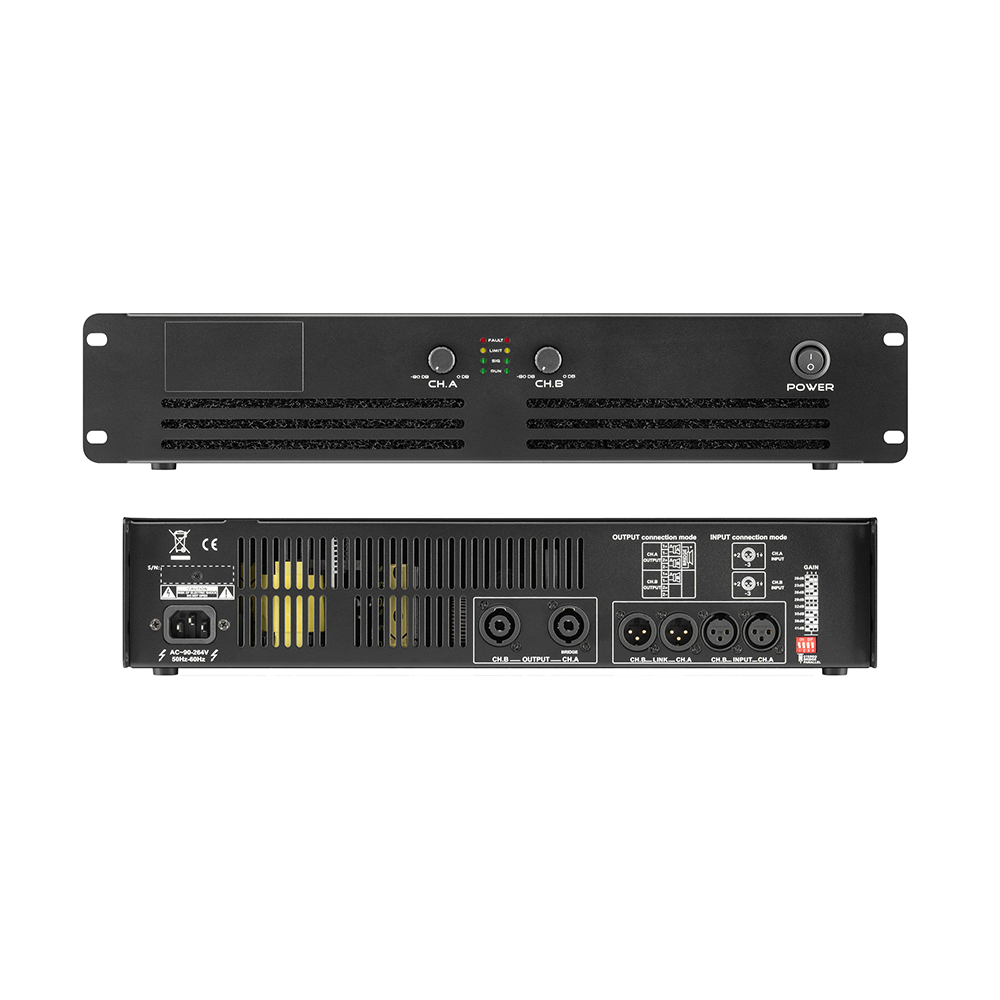
For reference, AUWAY's TD2500 Class TD amplifier delivers 2x2500W at 8Ω with less than 0.5% THD at 1/3 power and a damping factor above 400, specs built specifically for large-venue sound reinforcement where clean headroom matters most.
Choosing a suitable amplifier isn't just about picking the biggest wattage number on the spec sheet. It's about matching the amplifier's output characteristics to the speakers, the venue size, and the type of content being reproduced. The table below compares three amplifier types across common venue applications to illustrate how this matching works in practice.
Amplifier Type |
Example Model |
Power Output (8Ω Stereo) |
THD |
Best Suited For |
|---|---|---|---|---|
Class TD (hybrid) |
TD2500 |
2x2500W |
≤0.5% |
Large festivals, stadium subwoofer arrays, long touring rigs |
Transformer-coupled (Class H) |
MT400 |
2x400W |
<0.05% |
Medium venues, vocal clarity-focused systems, houses of worship |
GaN-based Class D |
DS-1300 |
2x1300W |
<0.05% |
Compact touring rigs, rental fleets, high-density rack installations |
Choose a transformer-coupled model like the MT400 if vocal clarity and warm low-end character matter more than raw power density, since its Class H design is tuned for musical accuracy in medium-scale rooms. Choose a GaN-based amplifier like the DS-1300 if you need maximum power in minimal rack space for touring, since GaN semiconductors allow roughly 30% space savings and lower power consumption compared to equivalent silicon designs. Choose a high-output hybrid like the TD2500 if you're covering a stadium or festival main stage, since its 2x2500W@8Ω rating and 7500W bridged output were built for heavy subwoofer loads.
Amplifier selection only solves half the equation. The speaker cabinet itself introduces its own distortion risks if its components can't handle the power being sent to them. Speaker building components that most affect distortion include:
Voice coil size and winding: Undersized voice coils overheat under sustained high power, causing thermal compression and audible breakup.
Crossover design: A poorly tuned crossover can send frequencies to drivers that aren't built to handle them, like low bass reaching a tweeter.
Cabinet construction and bracing: Flexing cabinet panels can introduce resonance and rattling that sounds like distortion but originates from the enclosure, not the electronics.
Driver power handling ratings: Feeding a driver more continuous power than it's rated for is one of the fastest ways to cause permanent damage and audible clipping artifacts.
Matching amplifier output to driver power handling, with enough headroom to avoid clipping but not so much that you risk overdriving the cone, is the balancing act every sound engineer has to manage.
Newer amplifier topologies have made meaningful strides in reducing distortion while improving efficiency. GaN (Gallium Nitride) semiconductor technology, for example, offers faster switching speeds than traditional silicon transistors, which improves transient response and reduces the audible smearing that can occur during fast musical passages. According to AUWAY's product documentation, the DS-1300 achieves a signal-to-noise ratio above 110dB A-weighted and a damping factor greater than 500 between 10Hz and 400Hz at 8Ω, specs that translate directly into tighter, cleaner bass reproduction on stage.
Hybrid Class TD designs take a different approach, blending the warmth of Class AB amplification with the efficiency of Class D switching. This hybrid approach is why the TD2500 can deliver massive power output while keeping THD below 0.5% even at substantial power levels.
Distortion in a live sound system is almost never a mystery once you break it down into its component causes: clipping, gain staging, impedance mismatches, and speaker limitations. Start by checking your gain structure from the mixing console through to the amplifier input. Then verify that your amplifier has enough clean headroom for the speaker load you're running, and confirm that your speaker components are rated to handle the power being delivered.
If you're outgrowing your current rig or specing a new system from scratch, prioritize amplifiers with proven low THD specifications, adequate damping factor, and power ratings that match your actual venue size rather than the largest number available. A well-matched, low distortion amplifier paired with properly rated speaker components will keep your mix clean no matter how loud the night gets.
What's the fastest way to diagnose distortion during a live show?
Start by soloing channels at the mixing console to isolate whether the distortion originates at the source, the preamp, or further down the signal chain. If the distorted signal sounds clean when soloed before the amplifier, the amplifier or speaker is likely the source.
Can impedance mismatches damage an amplifier?
Yes. Running an amplifier below its rated minimum impedance forces it to draw more current than designed, which can trigger thermal protection circuits or, in extreme cases, cause permanent damage to the output stage.
Is a more expensive amplifier always less likely to distort?
Not necessarily. Price doesn't always correlate with THD or headroom. Check the specification sheet for THD percentage, slew rate, and rated power at your speaker's actual impedance before assuming a higher price guarantees cleaner output.
How much headroom should a live sound amplifier have?
Most sound engineers recommend at least 3-6dB of headroom above your average operating level to absorb unexpected transient peaks without clipping.
Are GaN amplifiers worth it for touring rigs?
For touring companies prioritizing rack space and weight savings, GaN-based amplifiers like the DS-1300 offer a meaningful advantage, delivering high power density in a compact 2U chassis compared to equivalent silicon-based designs.


