
Views: 0 Author: Site Editor Publish Time: 2025-11-18 Origin: Site


A high-quality power amplifier is the heart of any serious audio setup. It takes the low-level audio signal from your source—like a preamplifier or mixer—and boosts it with enough power to drive your loudspeakers. Without the right power amplifier, even the most expensive speakers will sound weak and lifeless.
Choosing the best power amplifier for your needs can feel overwhelming. There are countless models on the market, each with different features, power ratings, and price points. Understanding the key specifications and how they impact performance is essential to making an informed decision. This guide will walk you through everything you need to know about power amplifiers, with a special focus on why Auway Audio has become a trusted name in the industry.
Whether you're setting up a home theater, a professional recording studio, or a live sound system, this article will help you find the perfect power amplifier to bring your audio to life. We will cover the different classes of amplifiers, essential features to look for, and how to match an amplifier to your speakers for optimal performance.
A power amplifier is an electronic device designed to increase the magnitude of power of a given input signal. The audio signal coming from your phone, turntable, or CD player is what's known as a line-level signal. This signal is too weak to move the drivers inside a loudspeaker. A power amplifier's job is to take that weak signal and create a much larger, more powerful electrical copy to send to your speakers.
Think of it as the engine of your sound system. It provides the necessary force to make your speakers vibrate and produce sound. The quality of this amplification directly affects the clarity, detail, and dynamic range of the audio you hear. A good power amplifier delivers clean, undistorted power, allowing your speakers to perform at their best.
Amplifiers are categorized into different "classes" based on their circuit design and how they operate. Each class has its own set of characteristics, affecting efficiency, heat generation, and sound quality.
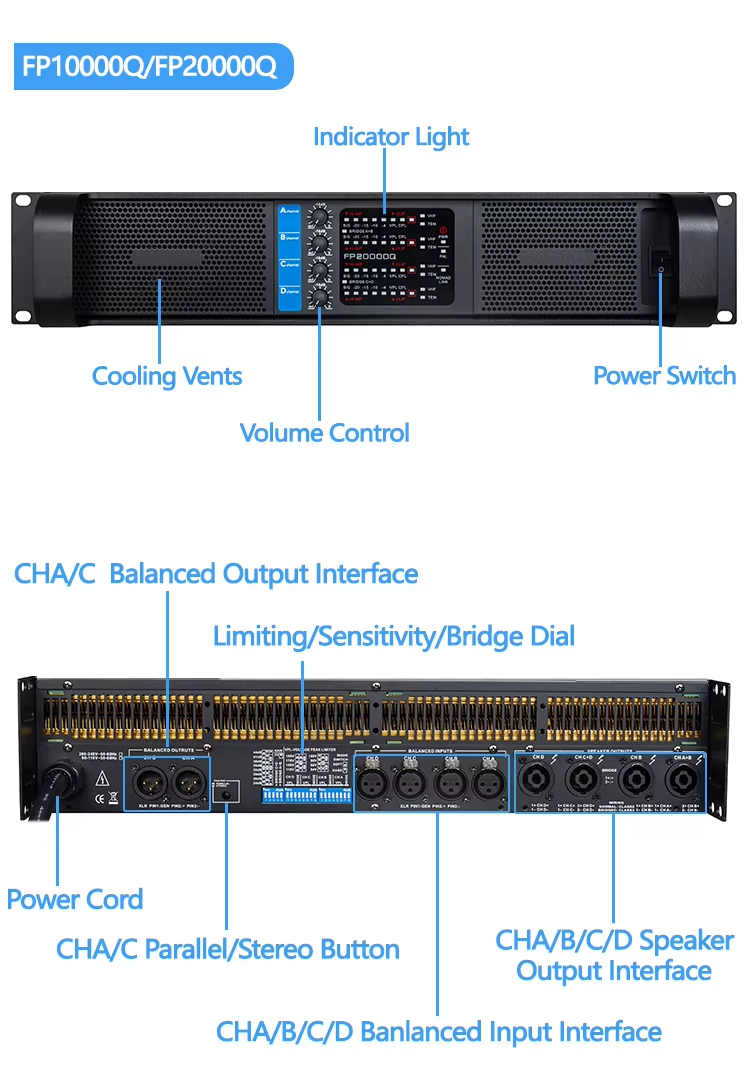
Class A amplifiers are known for their exceptional sound quality and linearity. The output transistors are always conducting, which eliminates crossover distortion—a type of distortion that can occur when transistors switch on and off. This constant operation results in the purest, most accurate signal amplification. However, it also makes Class A amplifiers highly inefficient, as they consume a lot of power and generate significant heat, even when there is no audio signal.
Class B amplifiers are more efficient than Class A. They use a push-pull design where two transistors handle the positive and negative halves of the audio waveform separately. This means each transistor is only active for half of the signal cycle, reducing power consumption and heat. The downside is the potential for crossover distortion at the point where one transistor hands off to the other.
Class AB amplifiers offer a compromise between the high fidelity of Class A and the efficiency of Class B. They operate in Class A mode at low power levels, ensuring clean sound for quiet passages, and switch to Class B mode for louder signals. This design significantly reduces crossover distortion while maintaining good efficiency, making Class AB a popular choice for both home and professional audio. Many Auway Audio amplifiers utilize this design to deliver a balance of performance and practicality.
Class D amplifiers are the most efficient type, often reaching over 90% efficiency. They use pulse-width modulation (PWM) to convert the analog audio signal into a series of high-frequency pulses. This switching design generates very little heat, allowing for smaller, lighter amplifiers that don't require bulky heat sinks. While early Class D designs were criticized for sound quality issues, modern advancements have made them a competitive option for everything from car stereos to high-end home audio systems.
Here is a simple comparison of the different amplifier classes:
Class | Primary Advantage | Primary Disadvantage | Best For |
A | Highest sound quality, no crossover distortion | Very inefficient, generates significant heat | Audiophile systems, recording studios |
B | More efficient than Class A | Potential for crossover distortion | Rarely used in modern audio |
AB | Good balance of sound quality and efficiency | More complex than Class A or B | Home audio, live sound, general use |
D | Highest efficiency, compact and lightweight | Can have sound quality issues in older designs | Car audio, portable systems, subwoofers |
When shopping for a power amplifier, you'll encounter a range of specifications. Here are the most important ones to pay attention to.
Power output, measured in watts, indicates how much power the amplifier can deliver to your speakers. It's crucial to match the amplifier's power rating to your speakers' power handling capabilities. An underpowered amplifier can lead to clipping (a form of distortion) when pushed too hard, which can damage your speakers. Conversely, an overpowered amplifier can also damage speakers if not used carefully. A good rule of thumb is to choose an amplifier with a continuous power rating that is about twice the speaker's continuous power handling rating.
Impedance, measured in ohms (Ω), is the electrical resistance of your speakers. Most home speakers are rated at 8 ohms, but some are rated at 4 or 6 ohms. Ensure your amplifier is compatible with your speakers' impedance. Most amplifiers can handle 8-ohm speakers, but not all can safely drive lower-impedance speakers. Auway Audio amplifiers are designed to be stable with a wide range of speaker impedances, providing versatility for different setups.
Total Harmonic Distortion (THD) measures the amount of unwanted distortion the amplifier adds to the audio signal. It is expressed as a percentage. A lower THD figure indicates a more accurate, cleaner sound. Look for amplifiers with a THD of 0.1% or lower for high-fidelity audio.
Signal-to-Noise Ratio (SNR) compares the level of the audio signal to the level of background noise (hiss) produced by the amplifier. A higher SNR, measured in decibels (dB), means a cleaner background and less audible noise during quiet passages. An SNR of 100 dB or more is considered excellent.
Auway Audio has built a reputation for producing high-quality, reliable power amplifiers that deliver exceptional performance. With a focus on robust engineering and user-friendly design, Auway products are a popular choice for both audio enthusiasts and professionals.
Auway amplifiers are known for their clean power delivery and low distortion, ensuring your music sounds exactly as the artist intended. They often incorporate Class AB designs to provide that perfect blend of audio fidelity and efficiency. Furthermore, Auway Audio pays close attention to build quality, using high-grade components and sturdy construction to ensure their amplifiers stand the test of time. Their products offer excellent value, providing performance that often rivals more expensive brands.
Selecting the right power amplifier is a critical step in building a great sound system. By understanding the different amplifier classes and key specifications like power output, impedance, THD, and SNR, you can make a choice that fits your needs and budget.
Consider the role Auway Audio can play in your setup. With a commitment to quality and performance, their range of power amplifiers offers a reliable and high-performing solution for any audio application. By matching the right amplifier to your speakers, you unlock the full potential of your system, ensuring a rich, detailed, and powerful listening experience for years to come.


