
Views: 0 Author: Site Editor Publish Time: 2025-11-06 Origin: Site


A high-quality sound system is essential for creating immersive audio experiences, whether you're at a live concert, a large venue, or even enjoying a home theater setup. While speakers are often the center of attention, the power amplifier is the unsung hero that drives the entire system. This crucial component takes a low-level audio signal and boosts it to a level that can effectively power your speakers, ensuring clarity, volume, and fidelity.
Understanding the role of a power amplifier is the first step toward building a sound system that meets your specific needs. This guide will walk you through the key aspects of power amplifiers, from their fundamental functions to the different classes available. We will also highlight how Auway Audio provides robust and reliable solutions for various audio applications, helping you make an informed decision for your next audio project.
A power amplifier, often called a power amp, is an electronic device designed to increase the magnitude of power of a given input signal. In an audio system, the signal comes from a source like a mixer, preamplifier, or audio player. This initial signal is too weak to drive loudspeakers on its own. The power amplifier's job is to strengthen this signal, providing enough electrical energy to move the speaker cones and produce sound at the desired volume without distortion.
Think of it as the engine of your sound system. Just as a car's engine determines its power and performance, a power amplifier dictates how loud, clear, and dynamic your audio will be. Without an adequate power amplifier, even the best speakers will underperform, sounding weak, distorted, or quiet. A well-matched amplifier ensures your speakers receive the clean power they need to operate at their full potential.
When selecting a power amplifier, you'll encounter several technical specifications. Understanding these terms is vital for matching an amplifier to your speakers and venue.
· Power Output (Watts): This is one of the most critical specs, indicating how much power the amplifier can deliver to the speakers. It's usually measured in watts (W) per channel. It is crucial to match the amplifier's power output with the power handling capabilities of your speakers.
· Impedance (Ohms): Impedance is the electrical resistance of a speaker, typically rated at 4, 8, or 16 ohms (Ω). A power amplifier must be able to handle the impedance of the connected speakers. Mismatched impedance can lead to poor performance or even damage the amplifier or speakers.
· Channels: This refers to the number of separate audio signals the amplifier can process. A mono amplifier has one channel, a stereo amplifier has two (left and right), and multi-channel amplifiers are used for surround sound or complex PA systems.
· Total Harmonic Distortion (THD): THD measures the amount of unwanted distortion the amplifier adds to the signal. A lower THD percentage means a cleaner, more accurate sound. High-quality amplifiers typically have a THD of less than 0.1%.
· Frequency Response: This indicates the range of frequencies the amplifier can reproduce accurately, measured in Hertz (Hz). A wide frequency response (e.g., 20 Hz to 20 kHz) ensures that all audible frequencies, from deep bass to high treble, are amplified faithfully.
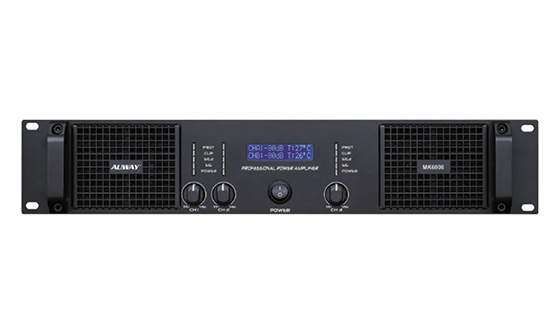
Power amplifiers are categorized into different classes based on their circuit design. Each class offers a unique balance of efficiency, performance, and heat generation.
Class A amplifiers are known for their exceptional sound quality and low distortion. The output transistors are always on, which results in a highly linear amplification process. However, this design is very inefficient, as it consumes a significant amount of power even when no signal is present, generating substantial heat.
Class B amplifiers are more efficient than Class A. They use a "push-pull" configuration where one transistor amplifies the positive half of the signal and another handles the negative half. This design reduces power consumption but can introduce "crossover distortion" at the point where the two halves of the signal meet.
Class AB combines the strengths of Class A and Class B. It operates in Class A at low power levels to eliminate crossover distortion and switches to Class B for higher power output. This provides a great balance of high-fidelity sound and improved efficiency, making it a very popular choice for both home and professional audio.
Class D amplifiers are the most efficient design, often reaching over 90% efficiency. They use pulse-width modulation (PWM) to convert the analog signal into a series of high-frequency pulses. This "switching" technology means they run much cooler and can be made smaller and lighter than other classes. Modern Class D amplifiers, like those from Auway Audio, deliver excellent sound quality that rivals traditional designs, making them ideal for professional audio where power and portability are key.
Amplifier Class | Efficiency | Linearity (Sound Quality) | Heat Generation | Common Use Case |
Class A | Low (~25%) | Excellent | High | High-end audiophile systems |
Class B | Medium (~50%) | Good (risk of crossover distortion) | Medium | Rarely used in modern designs |
Class AB | Good (~65%) | Very Good | Medium | Home audio, studio monitors |
Class D | Excellent (>90%) | Good to Excellent | Low | Professional PA systems, car audio |
Choosing the right power amplifier is a critical decision that directly impacts the performance of your entire audio system. By understanding key specifications like power output and impedance, and by selecting the appropriate amplifier class for your needs, you can ensure a powerful and clear audio experience.
At Auway Audio, we specialize in designing and manufacturing professional-grade power amplifiers that deliver reliability and performance. Our range of Class D amplifiers is engineered to provide maximum efficiency and pristine sound quality in a compact, lightweight package. Whether you're setting up a sound system for a live event, a large venue, or a custom installation, our products are built to meet the demands of professional use.
Explore our collection of power amplifiers to find the perfect solution for your audio needs. Let Auway Audio be the driving force behind your sound.


