Views: 0 Author: Site Editor Publish Time: 2026-06-08 Origin: Site


A digital amplifier works by converting incoming analog audio signals into a series of high-frequency digital pulses using pulse-width modulation (PWM). Transistors then rapidly switch on and off to amplify these pulses, which are subsequently filtered back into an analog sound wave to drive the speakers efficiently.
Sound engineers and venue managers constantly seek audio equipment that delivers massive power without taking up excessive space. Traditional analog amplifiers generate excellent sound, but they often produce extreme heat and require heavy transformers. This reality has driven a widespread shift toward digital amplification technology.
A digital audio power amplifier changes the fundamental way audio signals are boosted. Instead of continuously amplifying a signal and wasting excess energy as heat, these systems operate through rapid switching. This operational method drastically improves efficiency, allowing modern hardware to deliver thousands of watts from a compact, lightweight chassis.
Understanding the internal mechanics of these devices helps audio professionals make informed purchasing decisions. When you know exactly how a full digital amplifier processes sound, you can better match specific hardware to your venue's unique acoustic requirements. This guide explains the core technology behind digital amplification and highlights how top-tier models apply these principles in the real world.
A digital amplifier, often referred to as a Class D amplifier, operates as an advanced switching mechanism. When an analog audio signal enters the device, the amplifier's internal circuitry uses pulse-width modulation (PWM) to convert that continuous wave into a stream of digital pulses. The width of each digital pulse corresponds directly to the amplitude of the original audio signal.
Once the signal becomes a series of pulses, the amplifier's output transistors take over. These transistors act as high-speed switches, turning fully on and fully off billions of times per second. Because the transistors are never in a partially open state, they experience very little electrical resistance. This lack of resistance means the amplifier uses almost all of its drawn power to boost the audio signal, wasting virtually no energy as heat.
Finally, the amplified digital pulses pass through a low-pass filter. This filter smooths the rapid pulses back into a continuous analog waveform, which is necessary to physically move the speaker cones and produce sound. The result is a highly efficient process that delivers pristine, high-volume audio.
Efficiency stands as the primary reason audio professionals upgrade to digital hardware. Traditional Class AB analog amplifiers typically achieve around 50 to 60 percent efficiency. The remaining power dissipates as heat, requiring massive aluminum heatsinks and heavy cooling fans. In contrast, a modern digital power amplifier frequently exceeds 90 percent efficiency.
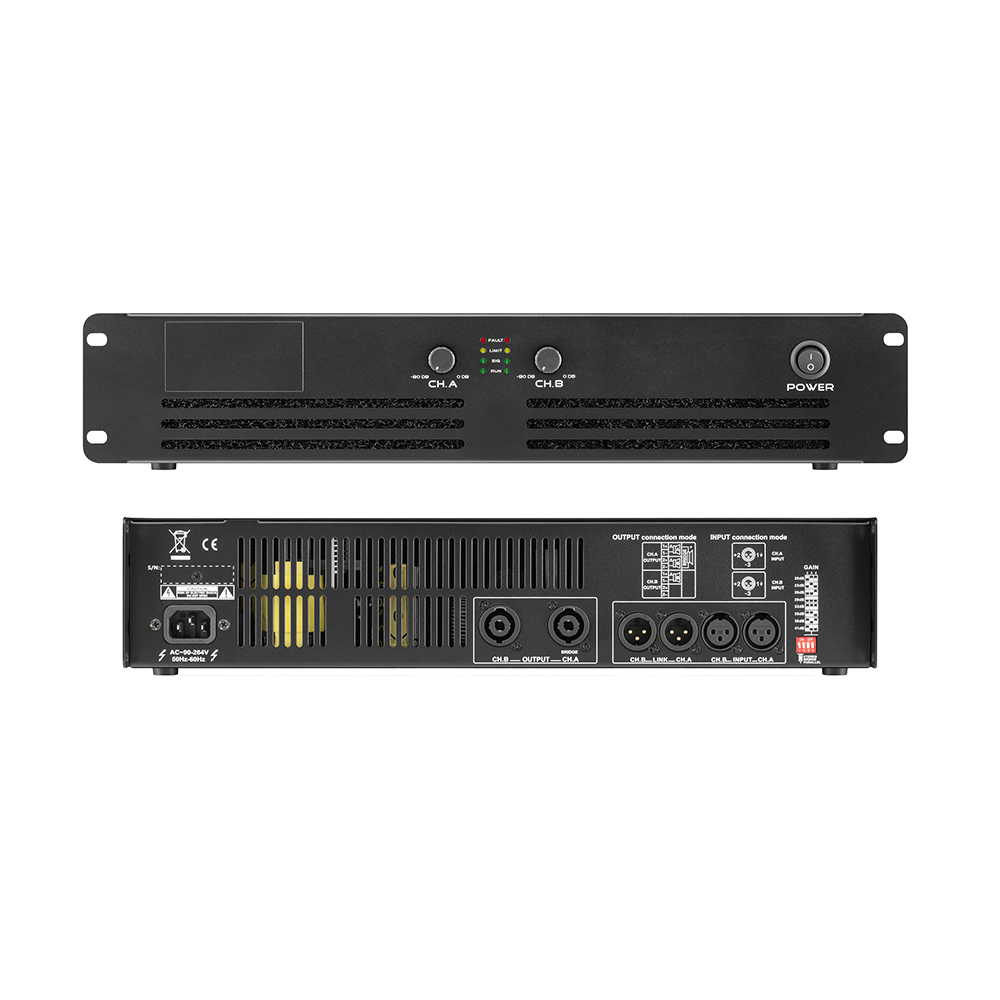
This dramatic increase in efficiency allows manufacturers to shrink the physical footprint of the hardware. For example, the Auway DS-1000 uses advanced Gallium Nitride (GaN) technology to deliver 2x1000W at 8 ohms while weighing only 6.25 kilograms [Auway Audio, 2024]. GaN components dissipate heat 40 percent faster than traditional silicon, which prevents overheating during long concert sets and significantly reduces the physical weight road crews must transport.
When designing a professional audio amplifier, manufacturers tailor the internal components to specific use cases. Some amplifiers focus on driving heavy subwoofers, while others prioritize multi-channel distribution for massive outdoor festivals. To understand how different configurations handle power, review this comparison of three high performance audio power amplifiers:
Amplifier Model | Output Power (4 ohms) | Technology Type | Net Weight | Best Use Case |
|---|---|---|---|---|
Auway FP20000Q | 4 x 4400W | Switching / Pure Amplification | 15.0 KG | Large stadiums and outdoor music festivals |
Auway D2400 | 2 x 4100W | Class D (Digital) | 9.0 KG | Driving powerful subwoofer speaker arrays |
Auway DS-1000 | 2 x 1800W | Class D with GaN Technology | 6.25 KG | Touring rigs and broadcast studio monitoring |
Each professional audio power amplifier listed above serves a distinct purpose. The FP20000Q provides brute force for massive spaces, while the DS-1000 prioritizes an ultra-lightweight form factor for easy transportation.
Proper amplifier use dictates that you match your hardware's capabilities to your specific performance environment. Applying the wrong amplifier can lead to blown speakers or an underpowered sound system.
Choose the Auway D2400 if driving heavy subwoofers matters more than powering high-frequency tweeters. Its specific design handles the sustained low-frequency demands of electronic and hip-hop music. Conversely, choose the Auway DS-1000 if you need to transport your equipment frequently. Its lightweight GaN architecture reduces physical strain on touring crews without sacrificing audio clarity. For permanent installations in mega-churches or stadiums requiring multi-channel distribution, select a high-output unit like the FP20000Q.
Always ensure your amplifier has adequate ventilation, even if it runs efficiently. Keep the cooling fans free of dust and debris, and utilize high-quality Speakon connectors to prevent accidental short circuits during performances.
Analog amplifiers constantly boost a continuous audio wave, which generates significant heat and requires heavy power supplies. Digital amplifiers convert the audio into rapid digital pulses, turning power switches fully on and off to maximize electrical efficiency and reduce hardware weight.
Yes. Modern digital amplifiers provide incredibly low total harmonic distortion (THD). Devices like the Auway DS-1000 offer a THD of less than 0.05% across the 20Hz-20KHz spectrum, making them perfectly suitable for critical listening in recording and broadcast studios.
Because digital amplifiers convert over 90% of their drawn electricity into usable audio power, they cost significantly less to operate over time than traditional analog systems. The exact cost depends on your local electricity rates and the duration of your events.
Touring professionals should prioritize amplifiers that feature lightweight construction and robust shock protection. Amplifiers utilizing Gallium Nitride (GaN) technology are highly recommended for touring, as they offer the highest power-to-weight ratio available on the market.
Digital amplifiers represent the pinnacle of modern sound engineering. By transforming analog signals into highly efficient digital pulses, these devices provide audio professionals with unprecedented power, clarity, and portability. Whether you manage a massive outdoor festival or a highly precise broadcast studio, integrating digital amplification will streamline your operations and elevate your audio quality.
Evaluate your venue's current power requirements, note the physical weight limits of your touring crew, and explore high-performance models that align with your specific acoustic goals.