
Views: 0 Author: Site Editor Publish Time: 2026-02-09 Origin: Site


In pro audio, small defects get amplified fast. They also get noticed fast.
Low THD means fewer extra harmonics added to the original tone. It keeps signals cleaner.
People often quote THD, yet they measure THD+N. Noise rides along.
So we care about both. We want the amp to stay honest.
It protects intelligibility in speech-heavy shows.
It reduces brittle edge on cymbals and strings.
It keeps monitor mixes easier to trust.
It lowers fatigue during long sessions.
THD feels abstract, until you stack channels. Then it becomes obvious.
Every stage adds a little. We try to keep each stage quiet.
| What we measure | What it tells us | What engineers should watch |
|---|---|---|
| THD | Harmonics added to a sine tone | Harmonic pattern, not only percent |
| THD+N | Harmonics plus noise inside bandwidth | Bandwidth, weighting, analyzer noise floor |
| FFT spectrum | Where distortion sits in frequency | Spurs, rising highs, odd-harmonic dominance |
Not every gig needs ultra-low numbers. Many gigs still benefit.
At FOH, we push levels hard. Distortion piles up, then vocals suffer.
In monitors, it matters even more. Musicians react to harshness instantly.
Cleaner transients help snare and vocal consonants.
Lower grit helps wedge mixes feel less “spitty.”
More predictable headroom helps faster soundchecks.
Consistency is money. Lower distortion reduces mystery complaints across venues.
It also supports repeatable presets. We want the same response every night.
In studios, we listen quiet. Low-level linearity matters a lot.
Low THD keeps imaging stable. It helps decisions translate elsewhere.
Installations run long hours. Heat rises, drift happens, distortion creeps.
Broadcast chains demand clean program paths. Noise plus distortion can break targets.
| Scenario | Main benefit of low THD | What to prioritize besides THD |
|---|---|---|
| FOH live PA | Cleaner clarity at high SPL | Power headroom, thermal stability, clip behavior |
| Stage monitors | Less fatigue, easier gain staging | Noise floor, protection transparency |
| Studio monitors | More accurate mix decisions | Low-level THD+N, channel matching |
| Installed venues | Predictable performance over time | Reliability, airflow, mains quality tolerance |
THD is useful. It still misses several real problems.
Music contains many tones at once. Interactions create intermodulation distortion.
IMD can sound rougher than plain harmonics. It hides inside mixes.
Harmonic distortion: extra harmonics from nonlinear gain.
Noise: hiss, hum, broadband junk inside bandwidth.
IMD: sum-and-difference products from multi-tone content.
Switching artifacts: spurs from Class-D switching behavior.
Some Class-D designs show low midband THD+N. Inductor nonlinearity can limit it.
Switching behavior can add extra components. Engineers fight them using loop design, modulation, filtering.
| What you see | What it often means | What you should do |
|---|---|---|
| Odd harmonics rising near clip | Hardening transfer curve, limited headroom | Increase headroom, adjust limiter strategy |
| High-frequency THD rise | Loop gain drop, output filter effects | Check THD vs frequency plots |
| Spurs near switching frequency | EMI coupling, layout or filter limits | Review grounding, shielding, output filter |
Specs can mislead. We can still read them like engineers.
At what power level did they measure THD or THD+N?
Which load did they use, 8 Ω or 4 Ω?
Which frequency did they pick, 1 kHz or full band?
Which bandwidth did they use in the analyzer?
Did they show a graph, or only one number?
One-number specs hide the curve. Curves tell the truth.
| Spec line | Good sign | Red flag |
|---|---|---|
| THD+N @ 1 kHz | Also includes frequency sweep plot | Only one datapoint, no conditions |
| THD+N vs power | Shows midband “valley” and clip knee | No curve, only “typical” text |
| Load condition | Lists 8/4 Ω, plus real-speaker notes | Unspecified load, unknown bandwidth |
Low distortion design is not only a schematic game. Layout dominates often.
Component quality matters too. Non-ideal parts inject signal-correlated errors.
Device nonlinear gain, under heavy current.
Bias drift from temperature changes.
Power supply modulation during dynamic peaks.
Return-path coupling on the PCB.
Magnetic coupling near high-current loops.
Currents loop through copper. They create fields. They induce errors nearby.
Even “clean” supply currents on paper can cause trouble in reality.
Keep high-current loops short and tight.
Separate noisy returns from quiet references.
Control impedance in sensitive nodes.
Place feedback sensing at the right physical point.
Ultra-low distortion design feels like a treasure hunt. The schematic gives clues. The PCB decides the ending.
Current loops create magnetic fields. They couple into sensitive nodes. It shows up as a “mysterious” THD+N rise.
Keep high-current loops short. Tight. Predictable.
Place feedback sense where voltage is real, not convenient.
Separate noisy returns from quiet references.
Shield sensitive traces from switching nodes and rectifier currents.
| Problem you see on the bench | Likely physical cause | Fast fix idea |
|---|---|---|
| THD+N improves, then worsens after wiring changes | Ground loop, return-path reroute, induced hum | Single-point reference, shorter returns, twisted pairs |
| Odd harmonics jump at high power | Thermal drift, rail modulation, protection interaction | Better thermal path, stiffer supply, gentler limiting |
| HF distortion rises first | Loop gain roll-off, parasitics, output filter effects | Check compensation, routing, filter placement |
Topology is a trade. We pick the pain we can manage.
Class AB stays intuitive. No output LC filter. Fewer EMI surprises.
Heat is the tax. Rack density suffers. Fans spin harder.
Pros: predictable behavior, simple output path, good HF linearity.
Cons: thermal drift, weight, efficiency limits.
Class D wins on efficiency. It also wins on power density. Touring loves it.
Switching adds challenges. Spurs, EMI, filter interactions, inductor nonlinearity.
Pros: high efficiency, lighter amps, smaller heatsinks.
Cons: filter design, EMI control, parts selection sensitivity.
Some designs add smarter modulation or multi-level schemes. It reshapes distortion. It can cut harmonic energy.
The goal stays simple. Make the output closer to the input. Less junk added.
Feedback is a main lever. It corrects nonlinear gain. It also fights supply ripple effects.
More loop gain, lower distortion. Until stability gets shaky. Then it bites.
Global feedback reduces overall distortion, across stages.
Local feedback linearizes a block, helps stability elsewhere.
Error correction targets a known nonlinearity, cancels part of it.
Open-loop distortion  ─►  Feedback reduces it
Low loop gain at HF   ─►  THD rises at high frequencies
Poor phase margin     ─►  ringing, spurs, unstable behavior
| Engineering choice | What it improves | What it can break |
|---|---|---|
| Higher loop gain | Lower midband THD | HF stability, ringing |
| More aggressive compensation | Stability margin | HF distortion, transient response |
| Local linearization | Predictable block behavior | Complexity, extra parts, layout demands |
Class D output filters look boring. They are not boring.
The inductor core changes under current. Inductance shifts. Distortion rises.
Pick cores for linearity, not only inductance value.
Place the LC filter close to the amplifier. Short switching loops help EMI.
Add damping when needed. Avoid peaking near the filter corner.
| Inductor spec you actually need | Why it matters for low THD | Practical check |
|---|---|---|
| Inductance vs DC current curve | Nonlinear L creates nonlinear output transfer | Ask vendor, test THD+N vs power |
| Core material and volume | Sets linearity range under load current | Choose larger core if budget allows |
| DCR and thermal rise | Heat changes behavior, raises resistance | Check temperature at sustained output |
Amp specs often come from short tests. Venues run long. Heat builds.
As temperature rises, bias moves. Rail sag becomes visible. Distortion shifts upward.
Rail droop during bass hits. It modulates output capability.
Ripple and rectifier noise coupling into small-signal ground.
Switching supply EMI coupling into feedback nodes.
We want protection. We do not want ugly artifacts.
Good protection feels transparent. It limits gracefully. It avoids bursty behavior near thresholds.
| Feature | Pro benefit | Design risk |
|---|---|---|
| Clip limiting | Prevents harsh clipping, protects drivers | Pumping, added distortion if too aggressive |
| Current limiting | Survives low-impedance dips | Nonlinear limiting creates IMD artifacts |
| Thermal throttling | Prevents shutdown mid-show | Audible compression if poorly tuned |
Measurement is a skill. It also is a trap.
If the analyzer noise floor is too high, THD+N lies. If grounding is messy, it lies again.
1 kHz sine: quick sanity check. Easy. Limited insight.
THD+N vs power sweep: shows the “valley” then the clip knee.
THD+N vs frequency: reveals loop gain limits, filter impacts.
Multi-tone: closer to music stress, exposes IMD.
Bursts: mimic crest factor, test supply dynamics.
Short cables. Balanced where possible.
Single reference ground. No daisy chain.
Keep switching supplies away from low-level inputs.
Confirm analyzer bandwidth and weighting. Compare same conditions.
| Mistake | What you see | Fix |
|---|---|---|
| Noise floor too high | THD+N “stuck” at a constant value | Increase level, lower bandwidth, improve shielding |
| Ground loop | 60/50 Hz spikes in FFT | Lift shield at one end, star reference, isolate |
| Wrong load | Results differ from datasheet | Match impedance, consider reactive loads |
Percent THD hides the story. FFT shows the story.
Even harmonics can feel “warm.” Odd harmonics can feel “edgy.” It depends on level, content, system.
Switching spurs can appear above audio band. They still leak. They can create intermod products.
Look for harmonic pattern, not only level.
Look for rising noise floor toward HF.
Look for discrete spurs, not tied to the harmonic series.
Fundamental ─► harmonics at 2f, 3f, 4f...
Odd-heavy pattern ─► “hard” nonlinearity risk
Random spurs ─► EMI coupling or switching residue
Selection is easier if we start from the job. Not from a brochure.
| Use case | Minimum questions we ask | Specs we prioritize |
|---|---|---|
| Live FOH | How loud, how long, which load dips? | THD+N vs power, thermal stability, clip behavior |
| Stage monitors | How many mixes, how close to feedback? | Low harshness near limit, noise floor, protection transparency |
| Studio / control room | How quiet is the room, what monitors? | Low-level linearity, channel matching, THD+N vs frequency |
| Installed sound | Duty cycle, rack airflow, service access? | Reliability, efficiency, predictable distortion under heat |
DSP shapes frequency response. It cannot undo distortion already created.
So we keep the power stage clean. Then DSP decisions stay trustworthy.
Set limiters before ugly clipping starts. Use the THD+N vs power knee.
Align gain staging. Avoid running one stage hot, another stage quiet.
Check behavior into real speakers. Reactive loads change margins.
| System element | How it affects distortion perception | Field tip |
|---|---|---|
| Limiter release time | Too fast sounds gritty, too slow sounds dull | Match to program type, verify at show level |
| EQ boosts | Boosted bands hit clip sooner | Cut first, boost last, keep headroom |
| Crossover point | Driver distortion interacts near crossover | Measure each band, then sum |
Even the best amp can sound bad in a bad setup. We have seen it.
Use proper power distribution. Avoid shared noisy circuits for sensitive racks.
Keep speaker cables sized right. Long thin cables waste headroom.
Maintain airflow. Dust filters matter. Fans matter.
Check connectors. A loose connector can mimic distortion.
Swap source. Confirm it is not upstream clipping.
Lower amp gain. Raise DSP output. Notice any noise change.
Move signal cables away from AC runs. Cross at 90 degrees.
Try a different circuit. Listen for hum change.
Lower distortion reduces rework. It reduces complaints. It saves time.
Efficiency also saves cost. Less heat. Smaller racks. Fewer shutdowns.
Rental fleets get fewer “it sounds weird” returns.
Installers spend less time chasing buzz and harshness.
Engineers trust presets more. Faster tuning days.
| Value driver | What it changes day to day | Why it matters |
|---|---|---|
| Cleaner headroom | Fewer limiter fights | More consistent mixes |
| Better thermal behavior | Less drift over long shows | More predictable sound |
| Lower noise contribution | Quieter pauses, less hiss | Higher perceived quality |
Myth: “THD below a percent is always inaudible.”
Reality: spectrum matters, plus level, plus content, plus system gain.
Myth: “Class D cannot be high fidelity.”
Reality: modern designs can measure extremely well. Magnetics still matter.
Myth: “One 1 kHz spec tells the whole story.”
Reality: you need sweeps. You need real loads. You need heat.
What are low-THD pro amplifiers used for?
They serve live sound, studios, broadcast chains, installations. Anywhere clarity and repeatability matter.
THD or THD+N, which one should we compare?
Use THD+N for practical comparisons. It includes noise in the same bandwidth. Check conditions every time.
Why do two amps share the same THD number yet sound different?
Different harmonic patterns, different noise floors, different clip onset. FFT tells more than one number.
What makes Class D THD rise at high power?
Inductor nonlinearity, filter behavior, supply stress, switching residue. It is common. It is measurable.
How do we validate performance in a venue fast?
Run safe sine checks, then listen for harsh onset. Confirm cabling and mains. Verify limiter behavior.
| Term | Simple meaning | Why it matters |
|---|---|---|
| THD | Harmonics added to the original tone | Shows basic linearity under a single-tone test |
| THD+N | Distortion plus noise in bandwidth | Closer to real measurement limits and practical noise impact |
| IMD | Products created from multiple tones mixing | More representative of music stress than a single sine |
| Loop gain | Error-correcting strength of feedback loop | Low loop gain at HF can raise THD there |
| Reactive load | Speaker impedance changes over frequency | Changes stability, changes distortion behavior |
Explore more related pages on AUWAY:
Low THD Power Amplifiers for Professional Applications product categories
Low THD Power Amplifiers for Professional Applications, DSP multi-channel option (DP-10000)
Low THD Power Amplifiers for Professional Applications for large venues (FP14000)
Low THD Power Amplifiers for Professional Applications in Class TD form (TD SERIES)
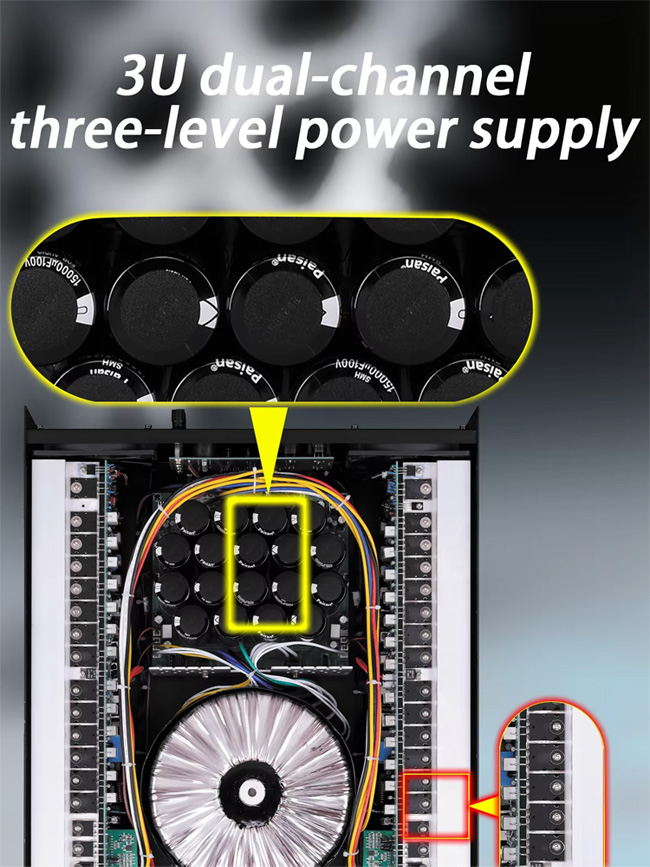
Low THD Power Amplifiers for Professional Applications, 3-stage power supply approach (AS1500)
When you choose an amplifier, you are buying outcomes. Clarity. Reliability. Predictability.
We can help you map the right model to the right venue. Keep it practical. Keep it measurable.
Venue type, audience size, SPL target.
Speaker count, impedance, wiring lengths.
Rack airflow limits, duty cycle, ambient temperature.
Your distortion target, plus measurement conditions you trust.
Official site: www.cn-auway.com


