
Views: 0 Author: Site Editor Publish Time: 2025-11-12 Origin: Site


Choosing the right power amplifier is crucial for any professional audio setup. The amplifier plays a vital role in boosting audio signals and ensuring that the sound reaches the audience with clarity and power. Whether you’re setting up a sound system for a small venue, large concert, or home studio, understanding key factors like power, impedance, functions, and budget can make all the difference. In this article, we will discuss how to choose the right power amplifier for professional audio, exploring each factor in detail to help you make an informed decision.
A power amplifier is a device that amplifies an audio signal to a level sufficient to drive loudspeakers, producing sound. It takes a weak audio signal from a mixer, audio source, or other device and increases the power so that the speakers can produce loud sound. Power amplifiers are often used in various professional settings, from live concerts and events to studio setups.
While they are critical to any audio system, power amplifiers differ in their design and capabilities. Some amplifiers focus on efficiency, while others prioritize sound quality. Understanding what a power amplifier does and its different types is key to selecting the right one for your needs.
There are several types of power amplifiers to choose from, each with its unique features. The most common types include:
● Class A Amplifiers: Known for their high audio quality, they are often used in audiophile settings due to their purity in sound. However, they are inefficient and generate a lot of heat.
● Class AB Amplifiers: These provide a good balance between performance and efficiency. They are the most common type used in both home audio and professional audio systems.
● Class D Amplifiers: Highly efficient, these amplifiers are commonly used in live sound applications due to their light weight and minimal heat production. They may not provide the same level of audio fidelity as Class A or AB but are ideal for high-power, compact systems.
● Class H Amplifiers: A more recent design, Class H amplifiers offer improved efficiency over Class AB while maintaining good sound quality. They adjust their supply voltage dynamically based on the input signal, providing energy savings and performance.
Type of Amplifier | Pros | Cons | Ideal Use Case |
Class A | High fidelity, low distortion | High energy consumption, heat | Studio settings where audio quality is critical |
Class AB | Good balance of quality and efficiency | More heat than Class D | General professional use, balanced performance |
Class D | Energy-efficient, lightweight | Slightly lower sound quality than Class A/B | Large venues, outdoor events, mobile setups |
Class H | High efficiency, good power management | More complex design | High-power systems, large-scale sound setups |
When selecting a power amplifier, it’s essential to compare these classes and understand their strengths and weaknesses. Class A amplifiers provide the best audio quality but are often too large and inefficient for most professional setups. Class AB amplifiers strike a balance, offering decent efficiency and high-quality sound. Class D amplifiers are ideal for large-scale events where efficiency is critical, while Class H amplifiers provide a good middle ground, offering both power efficiency and solid sound.
When choosing a power amplifier, one of the most critical factors is understanding how much power you need. Amplifier power is typically rated in watts, with the amount of power determining how loud the speakers can get. Too little power may lead to weak sound output, while too much power can cause distortion and damage to speakers.
Power ratings are divided into continuous and peak ratings. The continuous power rating indicates how much power the amplifier can deliver over an extended period, while the peak power rating refers to the maximum amount of power the amplifier can handle for short bursts. Understanding these ratings is essential to match the amplifier’s output to your speakers' capacity.
Matching the amplifier’s power output to the speaker’s power handling capacity is crucial for optimal sound performance. A good rule of thumb is to choose an amplifier that can deliver about twice the continuous power rating of the speaker. This ensures the amplifier can handle transient peaks without distorting or damaging the speakers.
For example, if your speaker has a continuous power rating of 350 watts, you would want an amplifier that can deliver at least 700 watts of power. This gives the speaker enough headroom to handle sudden loud moments in the audio, such as during an explosive musical performance or dynamic speech.
Impedance is a measure of electrical resistance, typically represented in ohms. It is essential to match the impedance of your amplifier and speakers to ensure efficient power delivery. Common speaker impedances include 4 ohms, 8 ohms, and 16 ohms. If the impedance between the amplifier and the speakers does not match, you risk reducing sound quality and potentially damaging your equipment.
Impedance mismatches can lead to inefficient power delivery, which may cause the amplifier to overheat or perform poorly. If the impedance is too high, the amplifier may not deliver enough power to the speakers. If the impedance is too low, the amplifier may over-deliver power, potentially causing speaker damage or even amplifier failure.
To avoid these issues, ensure that the total impedance of the speakers is within the amplifier’s rated output impedance. Many amplifiers support either 4-ohm or 8-ohm loads, so choosing the right amplifier that matches your speaker's impedance is essential.
When shopping for a professional power amplifier, you should consider several essential functions that will impact your setup’s overall performance:
● Gain Control: The gain control allows you to adjust the amplifier’s output level. This is particularly important for matching the amplifier with your audio source and ensuring consistent output.
● Crossover Filters: These filters divide the audio signal into different frequency ranges, directing the high and low frequencies to the appropriate speakers (e.g., sending bass to subwoofers and treble to full-range speakers).
● DSP (Digital Signal Processing): DSP enables the amplifier to manipulate and optimize audio signals. With DSP, you can adjust equalization, delay, and other factors to match the acoustics of the venue.
Feature | Description | Importance in Professional Audio |
Gain Control | Adjusts signal amplification to prevent distortion | Ensures clean, optimal output levels |
Crossover Filters | Divides signals into high and low frequencies | Improves sound clarity and performance |
DSP (Digital Signal Processing) | Enhances audio processing with customizable effects | Provides better control over sound characteristics |
Limiter Protection | Prevents overload and distortion | Safeguards equipment and maintains sound quality |
For more advanced applications, look for amplifiers with features that can boost performance:
● Limiter Protection: Limiters prevent the signal from exceeding a certain threshold, protecting the amplifier and speakers from damage due to excessive power.
● Thermal Management: Efficient cooling systems prevent the amplifier from overheating, ensuring reliable performance during extended use.
● Signal Processing: Some amplifiers offer built-in signal processing, such as equalization, phase adjustment, and other enhancements, allowing for fine-tuning and customization of the sound output.
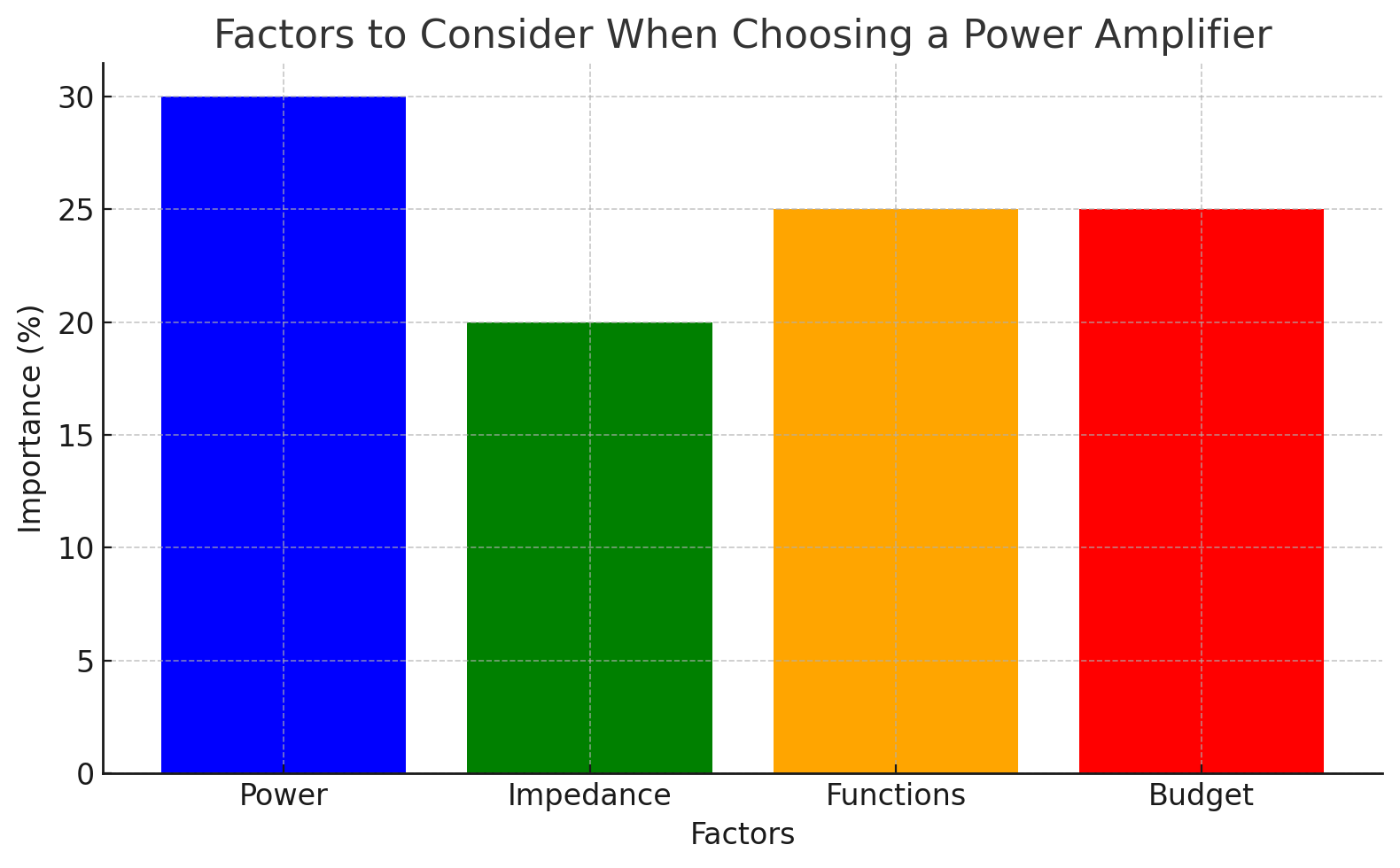
When choosing a professional power amplifier, it’s essential to balance quality with cost. Higher-end amplifiers often come with advanced features, better build quality, and improved performance, but they also come with a higher price tag. Consider your specific needs and the venue size to determine what features you truly need.
In professional settings, it’s better to invest in a quality amplifier that will stand the test of time, especially if you’re using it for large-scale events or installations. However, if you’re on a tight budget or only need the amplifier for occasional use, there are plenty of cost-effective options that still deliver solid performance.
Budget Range | Type of Amplifier | Ideal Use Case |
Under $500 | Entry-level Class D or AB | Small venues, home studios |
$500-$1500 | Mid-range Class AB, Class H | Medium-sized venues, corporate events |
Above $1500 | High-end Class A, AB, Class H | Large-scale events, touring sound systems |
While it might be tempting to go for a more affordable option, investing in a high-quality amplifier can save you money in the long run. Premium amplifiers typically have better durability, efficiency, and sound quality, making them suitable for demanding applications where reliability is crucial.
For example, in live sound applications, having a dependable amplifier that won’t overheat or distort under pressure can be invaluable. High-end amplifiers also tend to offer more flexibility, with features like built-in DSP and better impedance handling.
When selecting an amplifier, think about the type of event or installation you are setting up. For example, an amplifier for a small venue will have different requirements than one for a large concert hall or stadium.
● Small Venues: A modest amplifier with adequate power output and basic features may suffice for smaller venues or home studios.
● Large Events: For large venues or outdoor events, opt for more powerful amplifiers with advanced features like thermal management and limiter protection.
Ensure the amplifier you choose meets the specific audio needs of your setup. Consider factors like:
● Clarity: If sound clarity is a priority, invest in amplifiers with low distortion and high signal-to-noise ratios.
● Volume: If you need high volume levels, choose an amplifier with sufficient headroom to avoid clipping or distortion.
● Reliability: For critical applications, ensure the amplifier has the necessary protection and thermal management to perform reliably over time.
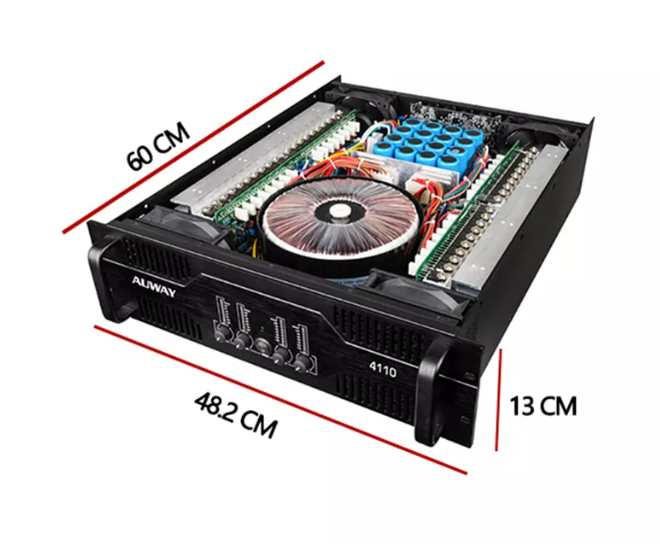
Imagine you are setting up a sound system for a large concert. The first thing to consider is the power requirements: you’ll need an amplifier with enough wattage to drive large speaker arrays at high volumes without distortion. Impedance matching is also crucial to ensure efficient power delivery. Finally, advanced features like thermal protection and limiter circuits can help prevent equipment failure during the event.
In a studio setting, where precision and sound quality are paramount, a high-quality amplifier with low distortion and clear signal processing will be key. While power output may not need to be as high as in live events, clarity and fidelity should be prioritized.
Choosing the right professional power amplifier involves balancing power, impedance, features, and budget. By understanding these factors, you can select an amplifier that ensures optimal performance and reliability. AUWAY offers a range of power amplifiers that combine energy efficiency, excellent performance, and durability. Whether for large events or studio setups, AUWAY’s amplifiers provide unmatched value and reliability for professional sound systems.
A: Power amplifiers are devices that boost audio signals to drive speakers. They are crucial in professional audio setups for delivering clear, loud sound in venues.
A: Consider factors like power output, impedance compatibility, amplifier features, and budget. Matching the amplifier to your speaker’s power rating is key for optimal performance.
A: Impedance refers to the electrical resistance of your speakers. It’s important to match the amplifier's impedance to avoid damage and ensure efficient performance.
A: The amplifier's power should match or exceed your speakers' power handling capacity, typically twice the speaker's continuous power rating to avoid distortion.
A: High-end amplifiers offer better sound quality, durability, and advanced features. If your budget allows, investing in quality amplifiers ensures long-term performance.


