
Views: 0 Author: Site Editor Publish Time: 2026-02-06 Origin: Site


We compare two amplifier paths people meet every day.One leans on transformers and linear output behavior. It feels classic.The other uses switching stages, often Class D. It feels modern.We keep it practical. You get clear choices fast.
Want cleaner sound at normal listening levels? We cover it.
Need high efficiency, smaller heat sinks, lighter gear? We cover it.
Care about EMI, wiring noise, real installs? We cover it.
We also clear up naming confusion. “Digital amplifier” often means Class D switching.“Transformer-based” can mean output transformers, or big linear power transformers.
| Quick goal | Pick first | Why people pick it |
|---|---|---|
| Portable audio, long runtime | Digital amplifier (Class D) | High efficiency, lower heat, compact designs. |
| Classic voicing, transformer coupling | Transformer-based power amplifier | Impedance matching options, isolation benefits, familiar behavior. |
| Multi-channel systems, dense racks | Digital amplifier (Class D) | Thermal scaling stays manageable across channels. |
We use simple language. We still respect engineering reality.
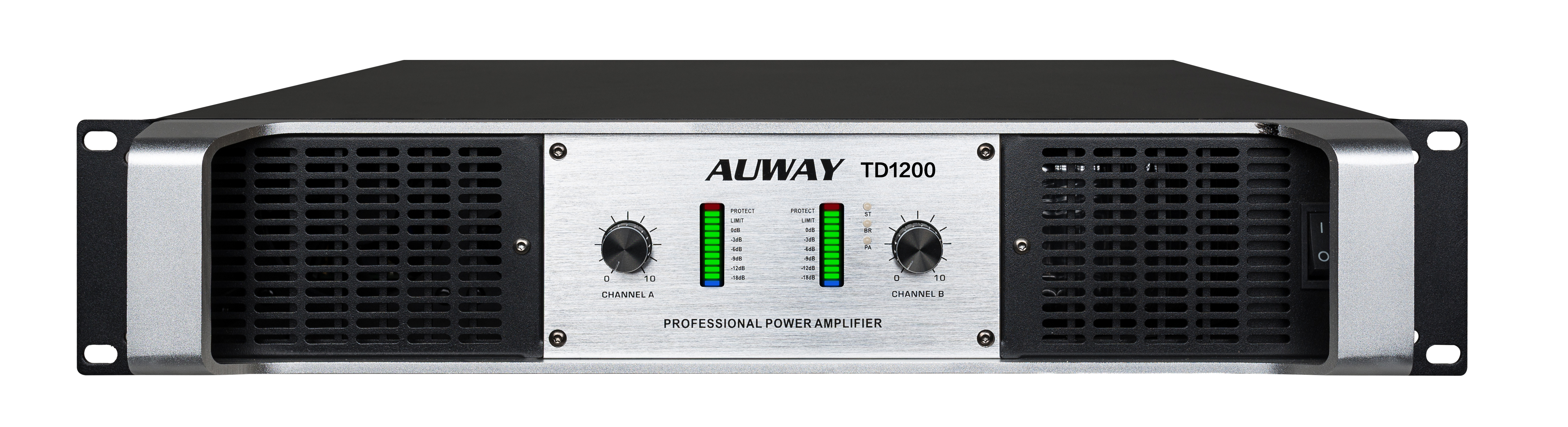
These words show up in specs and sales pages. We keep them simple.
| Term | Plain meaning | Why it matters for you |
|---|---|---|
| Power amplifier | Stage that drives a real load, often speakers. | It handles current, heat, distortion limits. |
| Efficiency (η) | Useful output power divided by supply power. | It predicts heat, battery life, enclosure size. |
| THD / THD+N | Extra harmonics and noise added by nonlinearity. | It changes timbre, harshness, perceived clarity. |
| EMI | Electrical noise radiated or conducted by circuits. | It can affect radios, DACs, mics, compliance tests. |
| Impedance | Speaker load varies across frequency and phase. | It changes control, bass damping, amp stress. |
| Output filter | Low-pass network after a switching output stage. | It reduces carrier energy. It helps EMI control. |
Keep one idea in mind. Speakers behave like reactive loads, not resistors.So two amps can measure similar, yet feel different in your room.
A power amplifier takes a small audio signal. It pushes a bigger one.It must deliver voltage swing and current drive. They travel together.Most tradeoffs live in the output stage. It runs hottest.
Linear stages pass a scaled waveform through active devices.
Switching stages flip devices on and off very fast.
Linear designs burn unused energy as heat. Efficiency drops fast.Switching designs waste less in output devices. They stay cooler.Here is a simple energy picture. It helps decisions quickly.
| Stage behavior | Energy flow feel | Typical practical consequence |
|---|---|---|
| Linear (Class A/AB style) | Supply → device → load, continuous conduction. | More heat, bigger sinks, heavier supplies. |
| Switching (Class D style) | Supply → switching bridge → filter → load. | Less heat, smaller box, more EMI attention. |
We are not chasing a single “best” amplifier. Context decides.
“Transformer-based” gets used in two ways. People mix them often.
An output transformer can match amplifier devices to speaker impedance.It also gives galvanic isolation. It helps break ground loops.Designers use it in tube amps and instrument amps a lot.
Pros: impedance transforming, isolation, balanced signal options.
Cons: saturation risk, bandwidth limits, added phase shifts.
Many traditional amps use large mains transformers. They support headroom.They pair well near Class AB designs. They trade size for stability.People notice the weight first. It feels “serious” on a shelf.Transformers also act as “insurance” in real systems. Noise problems happen.A transformer can reject common-mode interference in balanced links.
| Transformer role | What it does | What you might notice |
|---|---|---|
| Output transformer | Impedance matching, coupling, isolation options. | Different load behavior, possible voicing changes. |
| Power transformer | Mains voltage conversion, supply stiffness, headroom. | More weight, less portability, stable thermal expectations. |
| Signal transformer | Balancing, de-balancing, noise rejection on long runs. | Less hum and buzz in tricky installs. |
Most “digital amplifiers” in audio are Class D. They switch fast.They represent the waveform using PWM-like timing. Then they filter it.
Modulator creates switching duty cycles from the audio signal.
Power stage uses half-bridge or full-bridge switching.
Output low-pass filter reduces carrier energy and EMI.
Feedback can reduce distortion from bus variation and timing errors.
It sounds simple. Real performance depends on timing accuracy.Dead-time errors can raise distortion. Even tiny timing drift matters.Half-bridge stages can suffer “bus pumping” at low frequencies.So designers often prefer full-bridge for demanding audio loads.EMI needs respect. Switching edges can create ringing and interference.Layout choices matter a lot. They change noise, stability, compliance risk.
| Design factor | What goes wrong | What teams do |
|---|---|---|
| Dead-time | Nonlinearity rises, THD can jump quickly. | Calibrate timing, tune gate drive, add feedback. |
| Bus pumping | Bus voltage fluctuates, distortion increases. | Use full-bridge, add absorption paths, tune supply. |
| Output filter | Carrier leaks, EMI rises, measurements mislead. | Design LC carefully, validate on real loads. |
| PCB parasitics | Ringing spikes, radiated noise, device stress. | Short loops, solid grounding, controlled switching edges. |
Here is a tiny “efficiency feel” chart. It stays intuitive.
| Topology | Heat feel at high power | Typical user experience |
|---|---|---|
| Transformer-based linear amp | ██████████ | Runs warm or hot, needs space around it. |
| Digital amplifier (Class D) | ████ | Runs cooler, fits smaller enclosures. |
Sound quality feels personal. It still links to physics.We hear tone, dynamics, bass grip, low-level detail. They come from choices.So we compare what changes inside each approach. Then we map it to what you hear.
Transformer-based designs shape distortion via magnetics and linear devices.
Digital (Class D) designs shape distortion via switching timing, filtering, feedback.
Distortion is not one number. It has a “shape.” It matters a lot.
| What you notice | Transformer-based amp tends to involve | Digital (Class D) amp tends to involve |
|---|---|---|
| Warmth, saturation feel at high level | Core saturation risk, low-frequency headroom limits | Supply stress, filter interaction, clip behavior |
| “Clean” micro-detail at low level | Noise floor from front-end design, grounding decisions | Residual switching noise control, EMI discipline |
| Bass control and punch | Output impedance, winding resistance, load match | Output filter design, feedback strategy, load variation |
| Consistency across different speakers | Impedance matching options, transformer bandwidth limits | Filter + speaker impedance coupling, common-mode filtering |
Power supply behavior also changes sound in real rooms.Many Class D stages show gain tracking the bus voltage. Feedback reduces it.
THD+N at 1 W, 10 W, 1/8 power. Music lives near these zones.
Frequency response into a real speaker load, not a resistor.
Noise floor at idle. Ear near tweeter test, then meter test.
Temperature rise after 20–30 minutes, same volume.
Now a quick myth reset. It keeps us honest.
“Class D always sounds harsh.” Not true. Design quality decides.
“Transformers always sound warm.” Not true. Core, winding, headroom decide.
“Digital input means digital amplifier.” Not always. Many systems mix domains.
So we do not chase labels. We chase outcomes.
Efficiency sounds boring. It controls everything else.Heat drives size, cost, reliability, fan noise, case temperature.Linear Class AB often sits near 50% efficiency in practice.Class D often reaches around 90% in strong designs.
| Topic | Linear / transformer-based style | Digital / Class D style |
|---|---|---|
| Heat per watt delivered | Higher, more sink area needed | Lower, smaller sink possible |
| Battery runtime | Shorter, more loss | Longer, less loss |
| Power supply stress | Steady draw, big transformer often used | Fast edges, bus pumping risk in half-bridge cases |
Class D brings a special issue. Energy can flow back to the supply in half-bridge stages.It can pump bus capacitors, mainly below 100 Hz. Full-bridge avoids most of it.
| At similar loudness | Case heat feel | What you do in product design |
|---|---|---|
| Linear / transformer-based | █████████ | Give it vents, space, bigger metal parts |
| Digital / Class D | ████ | Watch EMI, tune filters, keep switching loops tight |
Efficiency wins no awards. It wins markets.
Transformer-based amps still make sense. They solve real problems.
You want a familiar harmonic profile.
You accept size, weight, heat in exchange.
Hum appears in studios, venues, long cable runs. It ruins a system fast.Transformers help isolation, balancing, noise rejection on messy installs.
RF receivers near audio chains
Measurement gear beside amplifiers
Legacy wiring layouts, weak shielding
Transformer-based solutions often win by risk reduction.
Digital amplifiers win most modern form factors. Efficiency drives it.
Phones, Bluetooth speakers, wearables
Power budget stays tight. Heat budget stays tight.
Soundbars, TVs, AV receivers, active speakers
Many channels, small box, no fan preferred
Here, Class D needs careful filtering. It also needs EMI planning.Filter choices influence efficiency, load safety, compliance risk.
In communications PAs, efficiency at back-off matters. New ideas use switched-transformer combining.Audio differs. The mindset still helps. Music sits below peak power often.
This section is for buyers and designers. It keeps debates short.
| Tradeoff | Transformer-based direction | Digital / Class D direction |
|---|---|---|
| Size and weight | Heavier magnetics, bigger metal parts | Lighter, higher power density |
| Thermal design | More heat, more sink volume | Less heat, still needs airflow planning |
| EMI / compliance | Often easier, fewer fast edges | Harder, switching edges create EMI challenges |
| Power supply behavior | Stable feel across supply variation | Gain can track bus voltage, feedback reduces it |
| Speaker load interaction | Impedance matching possible, bandwidth limits matter | Filter + load coupling matters, tuning matters |
| Risk factors | Transformer saturation, heat aging | Timing tuning, bus pumping, layout parasitics |
If weight matters, give Class D +2 points.
If EMI compliance risk matters, give transformer-based +2 points.
If battery runtime matters, give Class D +3 points.
If installation hum matters, give transformer isolation +2 points.
Score it. Then argue less.
We keep it step-by-step. It works for engineers and buyers.
Home hi-fi
Studio or venue
Portable or battery
Automotive
TV or soundbar
“I need it cool and small.”
“I need it quiet in a messy install.”
“I need it consistent across different speakers.”
“I want a certain sonic character.”
| Your priority | Check these specs or tests | Common winner |
|---|---|---|
| Low heat | Efficiency at real output levels, temperature rise test | Digital / Class D |
| Low noise in real installs | Grounding plan, isolation options, hum rejection test | Transformer-based (often) |
| Low EMI risk | EMI test reports, filter topology, layout quality | Transformer-based (often) |
| High power in a small box | Heatsink size, airflow, switching losses | Digital / Class D |
Play bass-heavy tracks. Watch supply stability.
Listen at low volume at night. Check hiss, buzz.
Measure THD+N at 1 W and 10 W. Compare results.
Check case temperature. Touch test, then thermometer test.
If Class D fails, it often fails via EMI or layout quality. Not the concept.
In audio marketing, yes, most times. People mean a switching output stage.
Output devices switch hard on or hard off. Less time in the lossy middle.
In half-bridge Class D, energy can flow back into the supply capacitors.It can pump bus voltage at low bass frequencies. It can raise distortion too.
Many do. They use LC filters to remove carrier energy and reduce EMI.
Full-bridge often improves demanding audio behavior. It also reduces bus pumping risk.
They can change impedance matching and isolation behavior. They can reduce hum issues.They can also add bandwidth limits or saturation risk if margins run tight.
Class D wins most cases. Efficiency drives runtime and heat.
We can end the argument in one line. Use the right tool for the job.
Pick Transformer-Based Power Amplifier vs Digital Amplifier decisions using your real constraints.
Pick transformer-based when isolation, classic behavior, install noise matter most.
Pick digital when efficiency, size, channel density matter most.
Neither choice guarantees great sound. Implementation decides the outcome.So we look past labels. We check heat, noise, filtering, load behavior.Do it once. Then you ship fewer returns. You also enjoy the music more.
Here are a few AUWAY pages, useful while comparing real products and scenarios:


