
Views: 0 Author: Site Editor Publish Time: 2026-11-18 Origin: Site


Live events and commercial installations demand flawless audio delivery at all times. Hidden thermal threats, however, often jeopardize the entire operation. Despite their impressive high efficiency, switching power amplifiers under sustained high-load conditions still produce significant waste heat. High-density commercial racks trap this thermal energy rapidly. Relying solely on generic manufacturer claims of "high efficiency" creates a dangerous false sense of security. If you fail to manage this heat effectively, the results are severe. Poor thermal control leads directly to thermal throttling, accelerated component degradation, or catastrophic mid-show shutdowns. This guide aims to solve this critical problem. We provide AV integrators, facility managers, and audio engineers an objective, actionable framework. You will learn how to evaluate, deploy, and maintain a cooling system properly. This knowledge ensures zero thermal downtime and ultimately protects your critical audio infrastructure.
Switching power amplifiers require deliberate thermal management strategies, regardless of Class D efficiency ratings.
Effective cooling dictates choosing between passive convection and active power amplifier fan cooling based strictly on the deployment environment (noise floor vs. thermal load).
Professional audio amplifier ventilation relies as much on external rack airflow engineering as on internal amplifier heat sink design.
Decision-makers should prioritize amplifiers with integrated thermal telemetry and DSP-managed protection circuits over baseline thermal shutoff switches.
Thermal shutdown is never just an isolated equipment failure. It represents a critical service interruption in live venues and commercial installations. When audio drops out mid-performance, you lose audience trust. You also damage your professional reputation. Venue owners demand uptime, and excessive heat directly threatens that expectation.
We must first address the efficiency paradox. Many technicians wonder why highly efficient gear still gets dangerously hot. An amplifier operating at 85% efficiency still wastes 15% of its consumed power as heat. If a rack pushes 10,000 watts of RMS output, it generates 1,500 watts of pure thermal energy. High-density rack configurations trap this energy quickly. The internal ambient temperature spikes if airflow remains restricted.
Failure vectors usually follow a predictable progression. First, you experience subtle output limiting. The system engages thermal throttling to protect internal components. You might notice compressed dynamics or reduced volume. Next, sustained high temperatures cause long-term capacitor degradation. The electrolytic fluid inside these capacitors dries out faster under intense heat. Eventually, this progression leads to a hard thermal fault. The equipment simply powers down to prevent a fire.
We define a successful implementation through strict criteria. You must maintain operating temperatures below a 40°C ambient threshold. Furthermore, you should observe zero thermal limiting during peak RMS output. Preventing amplifier overheating guarantees consistent audio quality. It also ensures reliable, stress-free show execution for the entire production team.
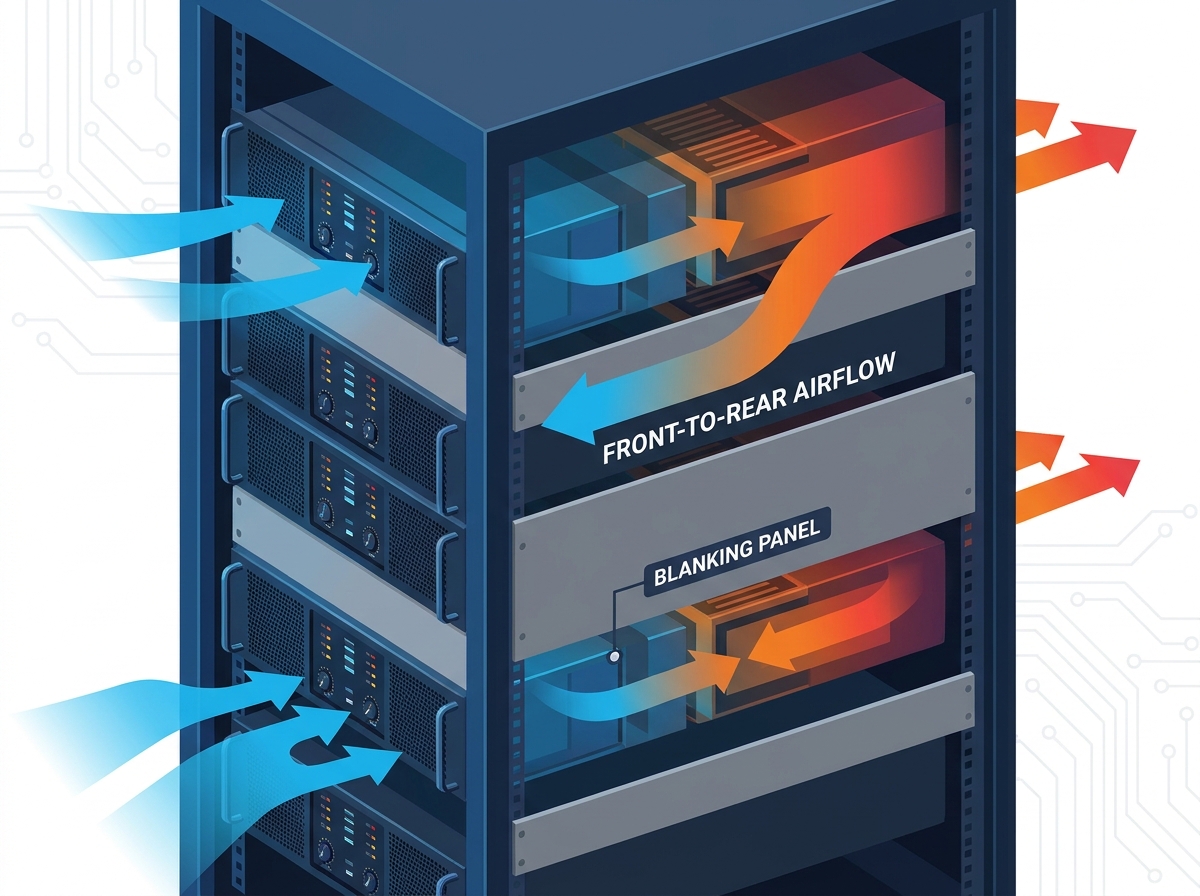
Engineers categorize thermal solutions into two primary architectures. You must match the architecture to your specific acoustic and thermal environment. A mismatch here guarantees systemic failure.
Passive convection relies exclusively on natural airflow. Hot air rises, pulling cool air over internal heat sinks automatically. This process requires zero mechanical assistance.
Pros: This method offers a zero noise floor. It remains ideal for critical listening spaces, recording studios, and intimate theaters. It also has zero moving parts, resulting in much lower dust accumulation over time.
Cons: Passive units require significant vertical rack spacing. They remain largely unsuited for high-density, high-output live sound environments. You cannot stack them tightly without risking thermal failure.
High-demand setups rely heavily on power amplifier fan cooling. Active systems force air through the chassis using mechanical fans.
Manufacturers offer variable-speed and fixed-speed fans. Variable-speed fans balance thermal dissipation against acoustic noise intelligently. They spin slower during quiet passages and ramp up during intense audio loads. Fixed-speed fans maximize cooling potential but introduce constant, unavoidable background noise.
Airflow routing is equally critical. You will find front-to-rear and side-to-side designs on the market. Front-to-rear airflow serves as the strict industry standard for closed racks. It pulls cold ambient air from the front aisle and exhausts hot air into the rear. Side-to-side routing often recirculates hot air dangerously in tightly packed enclosures.
Internal heat sink geometry plays a massive role in thermal transfer. Manufacturers optimize internal mass and fin density carefully. Aluminum and copper elements capture heat from power modules. These designs complement the power supply architecture directly. Densely packed fins increase surface area significantly. However, they require higher air pressure from fans to prevent dust clogging.
Cooling Architecture Comparison Chart
Cooling Architecture | Ideal Application Environment | Acoustic Impact (Noise) | Maintenance Frequency |
|---|---|---|---|
Passive Convection | Recording studios, quiet theaters | Silent (0 dBA) | Low (Minimal dust buildup) |
Active Variable-Speed | Churches, corporate AV spaces | Low to Medium | Moderate (Filter cleaning needed) |
Active Fixed-Speed | Stadiums, outdoor festivals | High | High (Frequent filter swaps needed) |
Deployment realities often contradict pristine laboratory specifications. An amplifier's internal cooling is only as good as the surrounding rack's ambient airflow. You can buy top-tier hardware, but poor rack design will ruin its performance.
Rack density rules generate constant industry debate. Many engineers argue for 1U spacing between units. Others strongly advocate for zero-clearance stacking to save space. True zero-clearance stacking only works if every unit utilizes strict front-to-rear airflow. Even then, ambient room cooling must be exceptionally robust.
Proper airflow management dictates several non-negotiable best practices. You must implement blanking panels immediately. Blanking panels seal empty rack spaces perfectly. They prevent hot exhaust air from recirculating back into the front intake vents. You must also manage positive and negative pressure carefully in server-style AV racks. Positive pressure in the cold aisle ensures fresh air easily enters the equipment.
HVAC dependencies present another major deployment challenge. Local cooling solutions fail completely if ambient room temperatures exceed manufacturer specifications. A highly efficient professional audio amplifier ventilation setup cannot cool internal components if the intake air is already 45°C. You must coordinate closely with HVAC technicians. They need to condition the equipment room properly to handle the cumulative BTU load.
You need a reliable, repeatable framework to evaluate your next purchase. Look closely at features driving specific operational outcomes.
Modern gear uses Digital Signal Processing (DSP) to protect vital components. Look for DSP integration specifically. It dynamically reduces output before reaching a hard shutdown threshold. This intelligent throttling keeps the show running at slightly lower volumes. It prevents the system from dropping audio entirely during a crisis.
A robust power amplifier cooling system should communicate its status continuously. Networked amplifiers offer real-time temperature monitoring. You can view this critical data via AV control software over Dante or AES67 networks. Remote monitoring allows you to spot thermal trends early. You can fix them before they become mid-show emergencies.
Enclosed commercial installations require strict fire safety adherence. Always verify electrical compliance standards beforehand. Look for UL or CE certifications on the spec sheet. These regulatory marks ensure the device will fail safely. They prevent the unit from sparking or catching fire during extreme thermal events.
You must evaluate the fan noise floor carefully. Manufacturers measure this noise in dBA. A recording studio requires virtually silent operation. Conversely, a noisy stadium can easily mask loud, high-RPM cooling fans. Match the acoustic compromise to your intended application correctly.
Even the best hardware degrades without proper care over time. Dust ingress severely impacts internal electrical components. Dust acts as an insulating blanket over heat sinks. This insulation blocks vital airflow and spikes internal temperatures quickly. You must use washable or replaceable intake filters.
Use the following shortlisting framework to guide your deployment strategy:
Define the specific environment first. Weigh acoustic sensitivity against the maximum expected thermal load.
Determine your required rack density. Audit the available external HVAC capacity in the equipment room.
Select passive or active cooling accordingly. Let the room characteristics dictate this choice.
Verify front-to-rear airflow compatibility. Ensure new units match your existing rack infrastructure seamlessly.
You need to take immediate next-step actions. Audit your current rack thermal loads today. Calculate the required BTUs for future HVAC planning. Finally, specify a modern Switching Power Amplifier with network-accessible thermal reporting for your next major upgrade.
When you select a reliable switching power amplifier, you secure the foundation of your live sound rig properly.
Preventing amplifier overheating represents a comprehensive systems-engineering challenge. It is never just a single feature listed on a basic spec sheet. You must evaluate the entire surrounding environment to ensure operational success.
Balancing rack density, active or passive cooling architecture, and software-based thermal protection remains crucial. This holistic approach is the only verifiable way to protect your valuable AV investment from catastrophic failure.
Take action before your next major event. Audit your current rack airflow meticulously. Check for missing blanking panels and clogged filters. Consult with a qualified integration specialist to verify your room's true HVAC capacity. Proactive engineering today prevents embarrassing and costly audio dropouts tomorrow.
A: High efficiency does not mean zero waste heat. An amplifier operating at 90% efficiency still converts 10% of its total consumed wattage into thermal energy. During high RMS wattage output, this small percentage equates to hundreds of watts of heat. Without adequate airflow, this heat rapidly builds up inside the chassis.
A: We strongly advise against replacing stock fans. Swapping fans voids your manufacturer warranty immediately. More importantly, aftermarket "quiet" fans typically deliver much lower CFM (Cubic Feet per Minute) airflow. This dangerous reduction starves internal heat sinks of necessary air, significantly increasing your risk of an unexpected thermal shutdown.
A: It depends heavily on the cooling architecture. Passively cooled units almost always require empty rack spaces to allow natural heat dissipation. Conversely, active front-to-back cooled units often support zero-clearance stacking. Always check the manufacturer guidelines before stacking high-power units tightly to avoid thermal traps.
A: Most manufacturers specify a maximum ambient intake temperature between 35°C and 40°C (95°F to 104°F). If the air entering the front of your rack exceeds this limit, internal components will overheat rapidly. Always monitor the cold aisle temperature to ensure it remains well below this critical threshold.
A: Maintenance frequency depends entirely on your deployment environment. In clean, climate-controlled corporate server rooms, an annual inspection usually suffices. However, in dusty outdoor festival environments or nightclubs with fog machines, you should clean or replace air filters monthly to prevent dangerous airflow restriction.


