
Views: 0 Author: Site Editor Publish Time: 2025-11-13 Origin: Site


Ever wondered what gives a concert its ground-shaking bass or makes a movie theater sound so immersive? The secret often lies in a powerful piece of audio technology: the high-power digital power amplifier. These devices are the engines behind professional audio systems, taking a low-power audio signal and boosting it to a level that can drive large speakers with clarity and force.
If you’re involved in professional audio—whether you're setting up a live event, managing a performance venue, or designing a high-end sound system—understanding these amplifiers is crucial. This guide explains what high-power digital power amplifiers are, how they differ from their analog counterparts, and what to look for when choosing the right one for your needs. We'll explore the key features and benefits that make them indispensable in modern sound reinforcement.
A power amplifier's job is straightforward: it takes a weak audio signal from a source like a mixer or pre-amp and increases its power to drive speakers. Digital power amplifiers, often called Class-D amplifiers, accomplish this with remarkable efficiency.
Unlike traditional analog (Class-A, B, or AB) amplifiers that use linear transistors to amplify the signal continuously, digital amplifiers work differently. They convert the incoming analog audio signal into a series of high-frequency digital pulses using a technique called Pulse Width Modulation (PWM). These pulses switch the output transistors on and off rapidly. The width of the pulses corresponds to the amplitude of the original audio signal. This switching process is incredibly efficient, as the transistors are either fully on or fully off, generating very little waste heat. Finally, a filter at the output stage smooths these pulses back into a clean, powerful analog signal that drives the speakers.
This innovative approach is what sets the high-power digital power amplifier apart, offering significant advantages for professional applications.
While both digital and analog amplifiers can deliver excellent sound, they have fundamental differences that impact their performance, efficiency, and physical design.
The most significant advantage of digital amplifiers is their efficiency. Class-D amplifiers can achieve efficiencies of over 90%, meaning more than 90% of the electrical power they consume is converted into audio output for the speakers. The remaining power is lost as heat.
In contrast, Class-AB analog amplifiers typically operate at around 50-60% efficiency. The other 40-50% is dissipated as heat. This difference is critical in high-power applications. Less heat means digital amplifiers can be built into smaller, lighter chassis without the need for massive heat sinks and cooling fans, making them ideal for touring and portable sound systems. Companies like Auway Audio have perfected this technology, creating powerful amplifiers that are both compact and reliable for demanding environments.
Because they generate less heat and require smaller power supplies and cooling systems, digital amplifiers are significantly smaller and lighter than their analog counterparts of the same power rating. A high-power digital power amplifier capable of delivering thousands of watts can weigh less than 10 kg (22 lbs), whereas an equivalent analog amplifier could easily weigh two or three times that. This makes installation, transportation, and racking much more manageable.
In the early days of Class-D technology, some audiophiles argued that digital amplifiers sounded harsh or "sterile" compared to the warmth of analog models. However, modern digital amplifier design has advanced considerably. With higher switching frequencies, improved filtering techniques, and sophisticated feedback loops, today's high-power digital amplifiers deliver sound quality that is virtually indistinguishable from the best analog designs. They provide a clean, accurate, and dynamic audio signal with extremely low distortion.
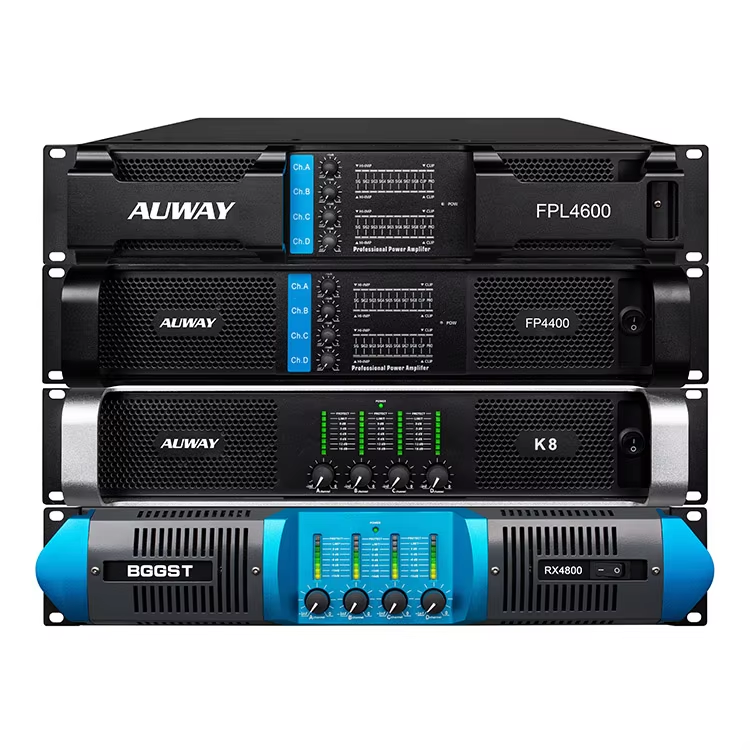
When selecting a digital power amplifier for your professional audio setup, several features can make a significant difference in performance and usability.
Power is the first specification most people look at. It's crucial to match the amplifier's power output to your speakers' power handling capabilities. A good rule of thumb is to choose an amplifier that can deliver about 1.5 to 2 times the speaker's continuous power rating (often called "Program" or "RMS" power). This headroom ensures the amplifier can handle dynamic peaks in the music without clipping, which can damage speakers and cause audible distortion.
Amplifiers come in various channel configurations.
· 2-Channel: The most common format, ideal for driving a pair of main speakers or subwoofers in stereo.
· 4-Channel: Highly versatile for running multiple monitor mixes, bi-amping speakers (using separate channels for highs and lows), or powering surround sound systems.
· 8-Channel: Perfect for complex installations, such as multi-zone audio systems in venues or large-scale surround sound setups.
Professional amplifiers should offer flexible input and output options.
· Inputs: Look for balanced XLR or TRS (Tip-Ring-Sleeve) inputs. Balanced connections are essential for professional use as they reject noise and interference picked up over long cable runs.
· Outputs: Speaker outputs are typically provided via Speakon connectors or binding posts. Speakon connectors are the industry standard for their locking mechanism, which prevents accidental disconnection.
Many modern high-power digital power amplifiers include built-in DSP. This feature is a game-changer, as it consolidates several pieces of outboard gear into one unit. Common DSP functions include:
· Crossovers: To split the audio signal between main speakers and subwoofers.
· Equalizers (EQ): To adjust the tonal balance and correct for room acoustics.
· Limiters: To protect speakers from being overpowered.
· Delay: To time-align speakers in large venues.
An amplifier with integrated DSP, like many models from Auway Audio, can simplify your signal chain, reduce potential points of failure, and save you money.
Reliable operation is non-negotiable in a professional setting. A quality amplifier will have comprehensive protection circuits to safeguard both the amplifier and the connected speakers. Look for protection against:
· Overheating (Thermal): Shuts the amp down if it gets too hot.
· Short Circuits: Protects against faulty wiring or speakers.
· Over-current: Prevents excessive current from damaging the output transistors.
· DC Protection: Blocks direct current from reaching and destroying your speakers.
When comparing different models, the technical specifications can seem daunting. Here is a breakdown of what the most important numbers mean.
Specification | What It Means | Good Value for Professional Use |
Power Output (Watts) | The amount of power the amplifier can deliver to the speakers. Often rated at 4Ω and 8Ω. | 1.5x - 2x the speaker's continuous power rating. |
Frequency Response | The range of frequencies the amplifier can reproduce accurately. | 20 Hz – 20 kHz (±1dB or less) |
THD+N | Total Harmonic Distortion + Noise. A measure of how much unwanted distortion and noise the amp adds. | < 0.1% |
Signal-to-Noise Ratio | The ratio of the audio signal level to the background noise level. | > 100 dB |
Damping Factor | The amplifier's ability to control the speaker cone's movement, especially at low frequencies. | > 200 (at 8Ω) |
Choosing the right high-power digital power amplifier is a critical decision that directly impacts the quality and reliability of your sound system. By prioritizing efficiency, power, connectivity, and built-in protection, you can build a system that delivers clean, powerful audio for any application.
Brands like Auway Audio specialize in developing professional audio equipment that meets the demands of live events and installations. Their range of digital power amplifiers combines cutting-edge Class-D technology with robust construction, offering a dependable solution for audio professionals.
Whether you're upgrading an existing setup or designing a new one from the ground up, investing in a quality digital power amplifier will ensure your sound is heard exactly as it was intended—loud, clear, and impactful.


