
Views: 0 Author: Site Editor Publish Time: 2025-12-09 Origin: Site


For anyone serious about sound—from audio engineers and live event producers to dedicated audiophiles—the ultimate goal is sonic purity. Achieving this requires an amplifier that can boost an audio signal without altering its original character. This is where low distortion amplification becomes critical. It ensures that the sound you hear is a faithful, powerful replica of the source, free from unwanted noise or artifacts.
Distortion can ruin an audio experience, turning crisp vocals muddy or sharp instrumentals into a fuzzy mess. Understanding how to minimize it is key to delivering professional-grade sound. This guide will explore the fundamentals of low distortion amplification, what causes distortion, and how modern amplifier technology, like switching power amplifiers, provides a solution for clean, powerful, and efficient audio.
In audio, distortion refers to any unintended alteration of the original sound signal's waveform. When an amplifier processes a signal, its job is to increase the signal's amplitude (volume) without changing its shape. However, no amplifier is perfect. Various factors can cause the output waveform to deviate from the input, resulting in distortion.
This "unfaithfulness" to the original signal can manifest in several ways:
Harmonic Distortion: The addition of harmonics (multiples of the original signal's frequencies) that were not present in the source. This can make the sound seem harsh, buzzy, or overly bright.
Intermodulation Distortion (IMD): The creation of new frequencies that are sums and differences of the original frequencies in a complex signal. IMD can make the audio sound muddy and less clear.
Clipping: Occurs when an amplifier is pushed beyond its maximum output capacity. The peaks of the sound wave are "clipped" off, resulting in a harsh, compressed sound.
The metric used to quantify this is Total Harmonic Distortion (THD), often expressed as a percentage. A lower THD percentage indicates a more accurate, low distortion amplification process.
Achieving clean sound is a technical challenge that amplifier designers have been refining for decades. Several design principles and components are crucial for minimizing distortion.
The "class" of an amplifier describes its circuit design (topology) and how it operates. Different classes offer trade-offs between efficiency and fidelity.
Class A: Known for excellent linearity and low distortion, but highly inefficient, generating significant heat.
Class AB: A compromise between Class A and Class B, offering good linearity with better efficiency. This is a common design for home and professional audio.
Class D: Often called "switching amplifiers," these are highly efficient (often over 90%). Early designs were criticized for higher distortion, but modern Class D amplifiers, like switching power amplifiers, have made massive strides and now offer exceptionally low distortion levels comparable to or even better than their linear counterparts.
Negative feedback is a foundational technique used to reduce distortion. A small portion of the amplifier's output signal is inverted and fed back into the input. This process corrects nonlinearities in the amplification stage, significantly lowering distortion and improving the stability of the amplifier. Properly implemented feedback is essential for high-fidelity performance.
The components used within an amplifier—transistors, capacitors, resistors, and power supplies—all impact its performance. High-grade components with tight tolerances ensure that the circuit behaves as designed, minimizing noise and distortion. The power supply, in particular, must be robust enough to deliver clean, stable power without sagging under heavy loads, which can prevent clipping and other forms of distortion.
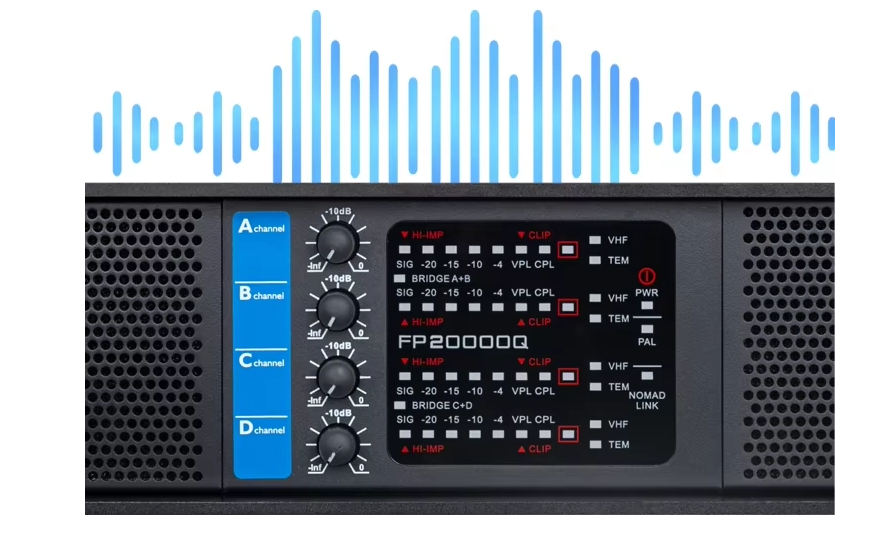
Modern professional audio has increasingly turned to switching power amplifiers (often Class D) to meet the demands for high power, efficiency, and clean sound. Unlike traditional linear amplifiers that operate with transistors in their linear region, switching amplifiers use transistors as fast-acting switches, turning them fully on or off at very high frequencies.
This switching action is what makes them so efficient. Because the transistors spend very little time in the "in-between" state where most energy is lost as heat, switching amplifiers run cooler, are lighter, and can be packed into smaller chassis.
Auway Audio’s Switching Power Amplifiers are engineered to deliver benchmark performance by combining this efficiency with low distortion amplification. They integrate advanced features to ensure pristine sound quality:
Low Total Harmonic Distortion (THD): By using precise switching circuits and advanced feedback loops, these amplifiers maintain the integrity of the audio signal, ensuring accurate sound reproduction.
High Signal-to-Noise Ratio (SNR): A high SNR means the audio signal is significantly stronger than the background noise floor of the amplifier, resulting in a cleaner, more detailed sound.
Advanced Cooling Systems: Despite being highly efficient, high-power amplifiers still need effective cooling. Robust cooling systems ensure the amplifiers operate reliably even under demanding conditions, preventing thermal issues that could introduce distortion.
Feature | Class A Amplifier | Class AB Amplifier | Class D Switching Amplifier |
|---|---|---|---|
Efficiency | Very Low (~20-25%) | Moderate (~50-65%) | Very High (>90%) |
Heat Generation | High | Moderate | Low |
Distortion | Very Low (Historically the benchmark) | Low | Very Low (With modern designs) |
Size & Weight | Large and Heavy | Moderate | Small and Lightweight |
Primary Application | High-end audiophile gear, low-power applications | Home audio, studio monitors, some pro audio | Pro audio, live sound, car audio, powered speakers |
Distinguishing Feature | Always-on transistors for maximum linearity | A balance of linearity and efficiency | High-frequency switching for maximum efficiency |
This table illustrates why switching power amplifiers have become the standard for professional applications. They deliver the power and low-distortion performance needed for large venues and touring rigs without the weight and inefficiency of older designs.
When selecting an amplifier, consider the requirements of your application. For a large concert hall or outdoor festival, you need immense power and reliability. An amplifier like the Auway Audio FP14000 or FP20000Q, designed for demanding sound systems, provides high-current output with the low distortion amplification necessary for clear, powerful sound reinforcement.
For studio engineers or venue managers, versatility and seamless integration are key. Amplifiers with multiple channels and compatibility with various mixers and speakers allow for flexible setups. The key is to find a solution that offers not just power, but clean, reliable power.
The pursuit of perfect sound reproduction continues to drive innovation in amplifier technology. As listener expectations rise and professional demands grow, the need for powerful and clean amplification has never been greater. Modern switching power amplifiers represent a significant leap forward, proving that high efficiency and high fidelity can coexist.
By focusing on low distortion amplification, you ensure that your audience hears the music, speech, or audio exactly as it was intended—just louder.
Ready to experience the difference that professional-grade, low-distortion amplification can make? Explore Auway Audio's range of switching power amplifiers and find the perfect solution for your sound system.


